Orion Optics 12” Dall Kirkham (Takahashi Mewlon 300 Clone) Review
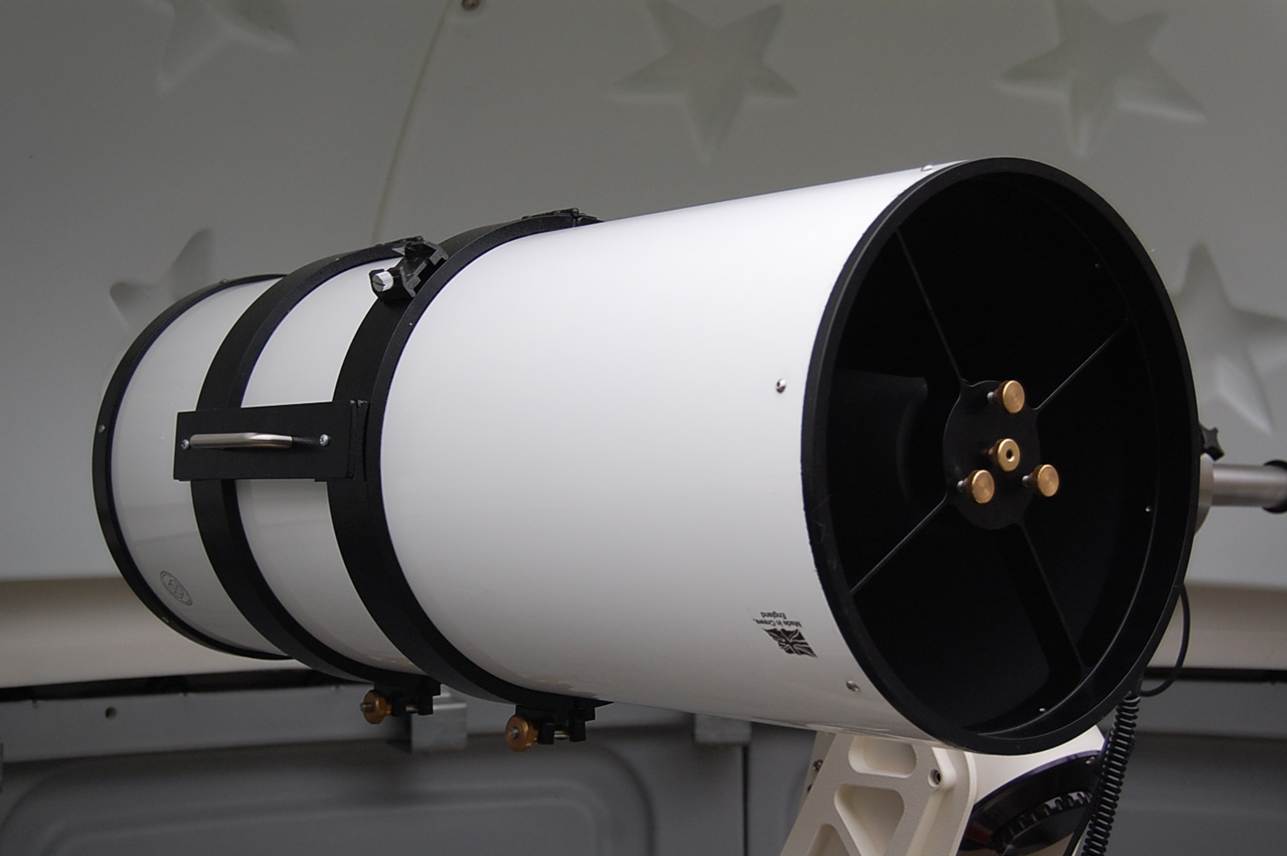
I had long wanted to try a big reflector: specifically, a
Takahashi Mewlon 300 (ever since I had seen one at
APM telescopes on a colossal EM500 mount). What a magnificent beast! And the
word on the forums was that the big Mewlon was the
ultimate ‘planet killer’.
Unfortunately, there was a problem or three with my dreams of
a Mewlon 300. First was the cost – truly
astronomical. Then there was its vast size and weight (back then I had no
dome). Third was that I had no mount near big enough.
I had been mightily impressed with the planetary and lunar views
through an 8” 1/10th wave Newtonian from Orion Optics –
an English manufacturer of high quality mirrors. Their little OMC140 Mak’
had been optically excellent as well.
So I approached Orion to see if they could build me a
lighter, cheaper Mewlon 300 clone. The upshot was
that Barry Pemberton at Orion Optics reckoned he could make a near-identical
scope at half the weight and a quarter the cost, one that would fit on the
mount I had at that time – a Tak’ EM200.
I ordered on the basis of a basic optical design to my specs
and then moved abroad and promptly forgot about it - probably a good thing,
given it took a while for them to build it … really quite a while.
Design and Build
Over two years later, back in England, I got a surprise call
from Orion. So I drove down the motorway to Crewe one lunchtime and there was
my new Mewlon 300 clone: big and white and shiny and
sitting on a Losmandy G11 in Orion’s cluttered
factory. Excited? Oh yes.
I was generally very pleased with the result. The workmanship
looked good.
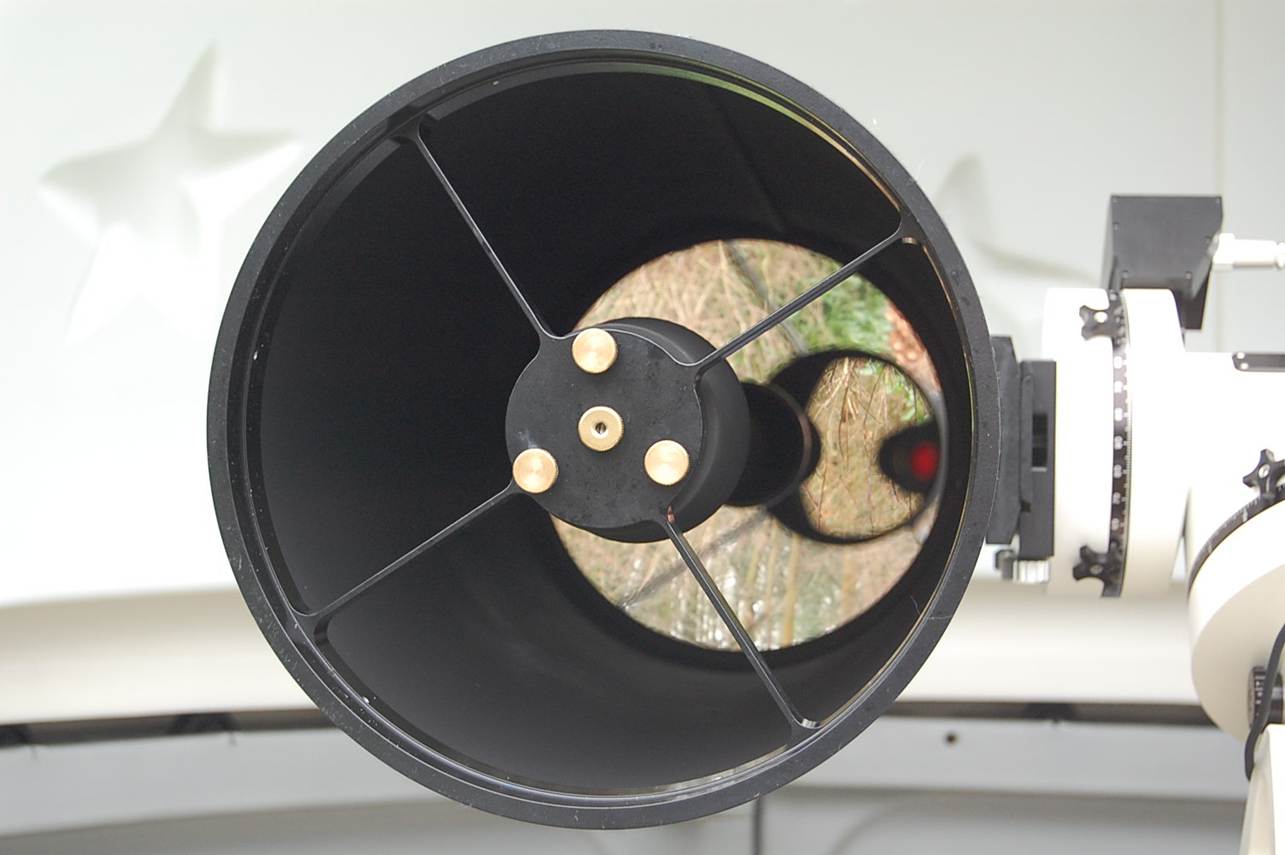
Thick-vane spider and 37% secondary baffle: not ideal for a
planetary reflector.
Optics – Not
exactly what I’d asked for
The Takahashi Mewlon series are a
type of Cassegrain, a pure reflector, called a Dall-Kirkham. I won’t bore
you with too many details, but it all comes down to curves. In a Classical
Cassegrain, the primary is a parabola, the secondary a hyperbola: both quite
tricky to make well (the primary having steep curves at F3 or F4).
By comparison, a Dall-Kirkham has an elliptical primary and a
spherical secondary, both easier to make. The catch? Both types are very sharp
on axis, but the DK suffers from much worse off-axis coma. But for an
equatorially-mounted planetary scope that hardly matters, which is why
Takahashi chose the DK for their Mewlons.
The original Mewlons were designed
as Lunar and planetary scopes, so they have a central obstruction of ~30%,
smaller than a typical SCT’s at ~35%. This is to maximise contrast.
Meanwhile, I had specified an even smaller secondary - a maximum of 25%. Having
a small secondary might make the scope less ideal for deep sky, but this was a
dedicated planetary scope for me after all.
In the event, the secondary was indeed 25%, but behind it was
a conical baffle extending out to 37% (bigger than most SCTs’!) Ouch!
Unfortunately, I didn’t notice this for some time after I had taken
delivery of the big DK; Barry from Orion explained that it was to make the
scope good for full-field astrophotography, which it does, but that’s not
what I wanted the scope for!
A more welcome innovation was the primary mirror - conical to
save weight, centre-supported and Zygoed at a
spectacular 1/8th wave, the latter a remarkable achievement for a
12” F3.
Tube
The tube was Orion’s usual seamed sheet-metal, inherited
from their Newtonians (they mainly seem to use carbon fibre now), but it had
kept the weight to under 15kg as promised.
At the front end, Orion had fabricated a CNC spider with thick
integrated vanes and mirror support for collimation stability. Thick vanes are
good for imaging because they mean shorter spikes, but less good for planets
because they can reduce contrast – more evidence this wasn’t the
scope I’d asked for at all!
At the other end, their CNC mill had hewn out a nifty primary
cell with opening shutters for fast cool-down, an excellent feature.
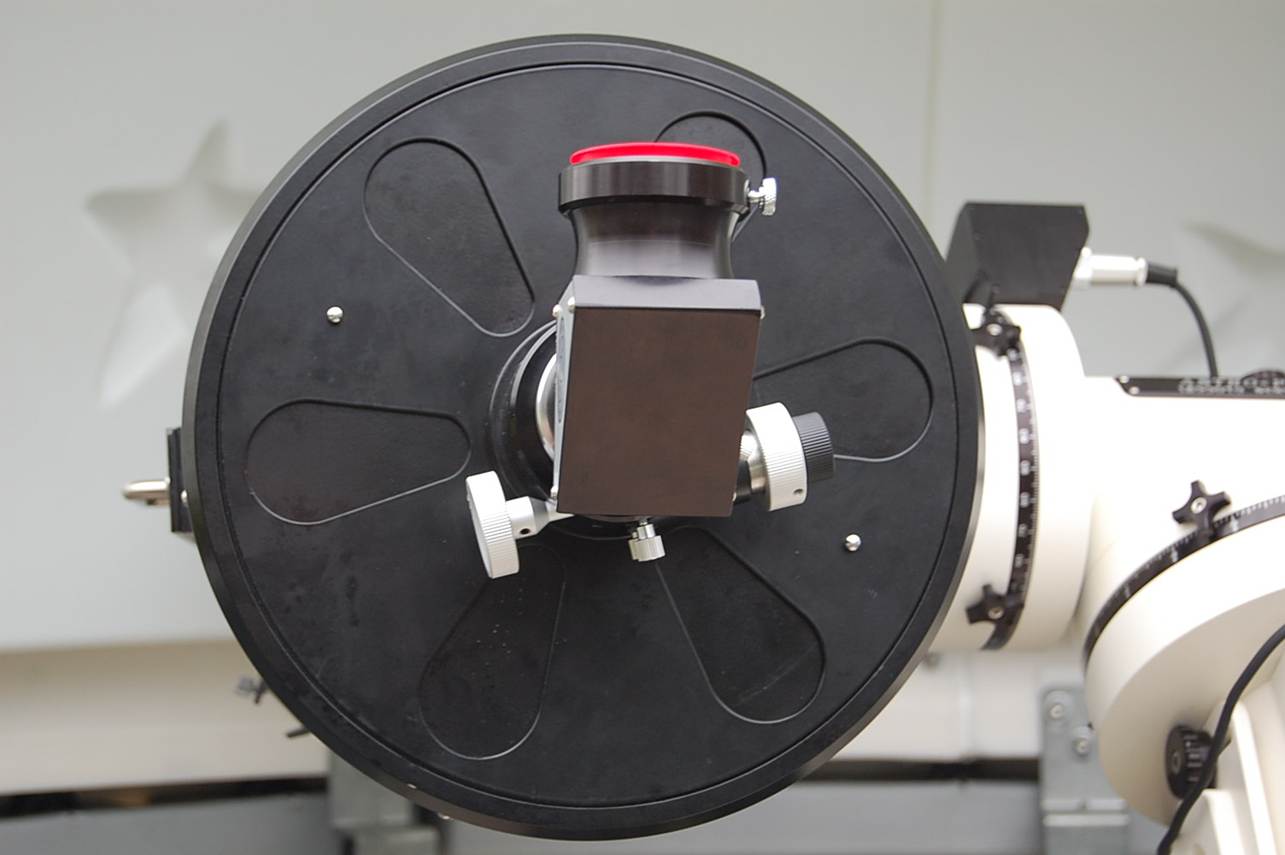
Vented rear cell – a clever innovation that means
remarkably quick cool-down for a big Cassegrain.
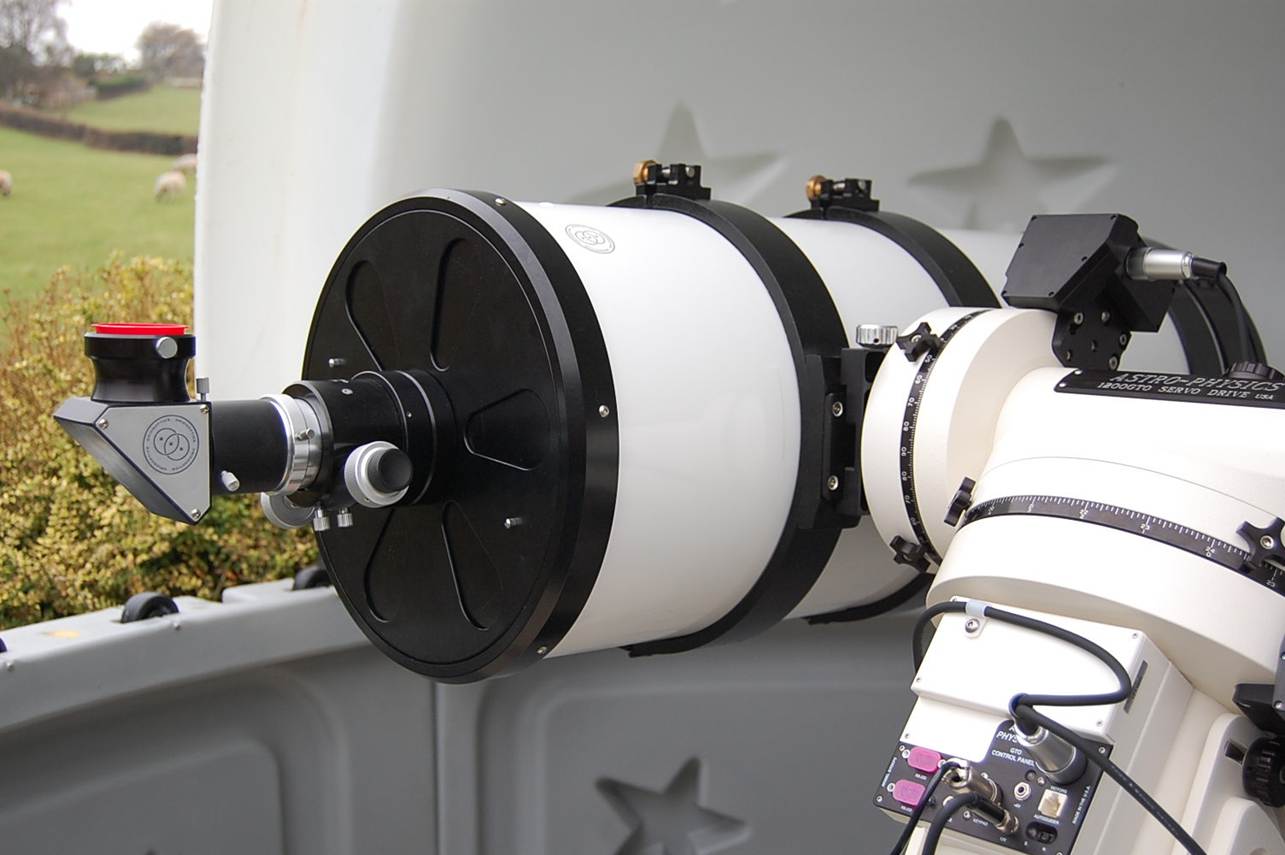
TS Crayford focuser and mandatory extension tube.
Focuser
The focuser was another (smaller) niggle. I had originally
asked for a Feathertouch, but had been persuaded to
go for Orion’s own (then new) CNC Crayford. Unfortunately, Orion’s
focuser was still under development, so I they had fitted a fast-food Chinese
Crayford from Teleskop Service instead.
The TS focuser would have been fine, but in order to get the
tube length down and provide lots of back-focus, the scope had been designed to
use an extension tube for most eyepieces (with a 3.6m focal length, long FL
eyepieces are the only ones that are useful). Trouble is the extension places more
leverage and weight on the focuser and it struggles, often racking out of its
own accord.
Mounting
Trying to get the big DK stably mounted is a salutary tale
– one worth relating.
As I said, this was intended as a big-league planetary scope
that would mount on my much-loved EM200. The EM200 is conservatively rated at
18kg, which given the 12kg weight of the Dall Kirkham should have been fine ...
Except that add tube rings, a diagonal, eyepiece, dovetail-plate, finder (and
at 3.6m F.L., you need a finder!) and it pushes 20kg, making the poor EM200
groan.
So in the end I admitted defeat, sold the EM200 and had to
upgrade. But upgrade to what? A problem with this hobby is the mere handful of
mounts that take 20kg. Consequently, the DK eventually led me to buy an AP1200,
a major expense I hadn’t really wanted. The moral of the tale? Be
realistic when it comes to what you can expect your mount to hold.
Even after the upgrade, the DK’s sheer size caused me
trouble, making it tricky to manoeuvre in my little Pod observatory.
What’s more, mounted via a Losmandy dovetail,
vibes are a bigger problem than with my big refractor which bolts to a fixed AP
plate.

It just clears the POD ... just, but careful manual slewing
is the only way.
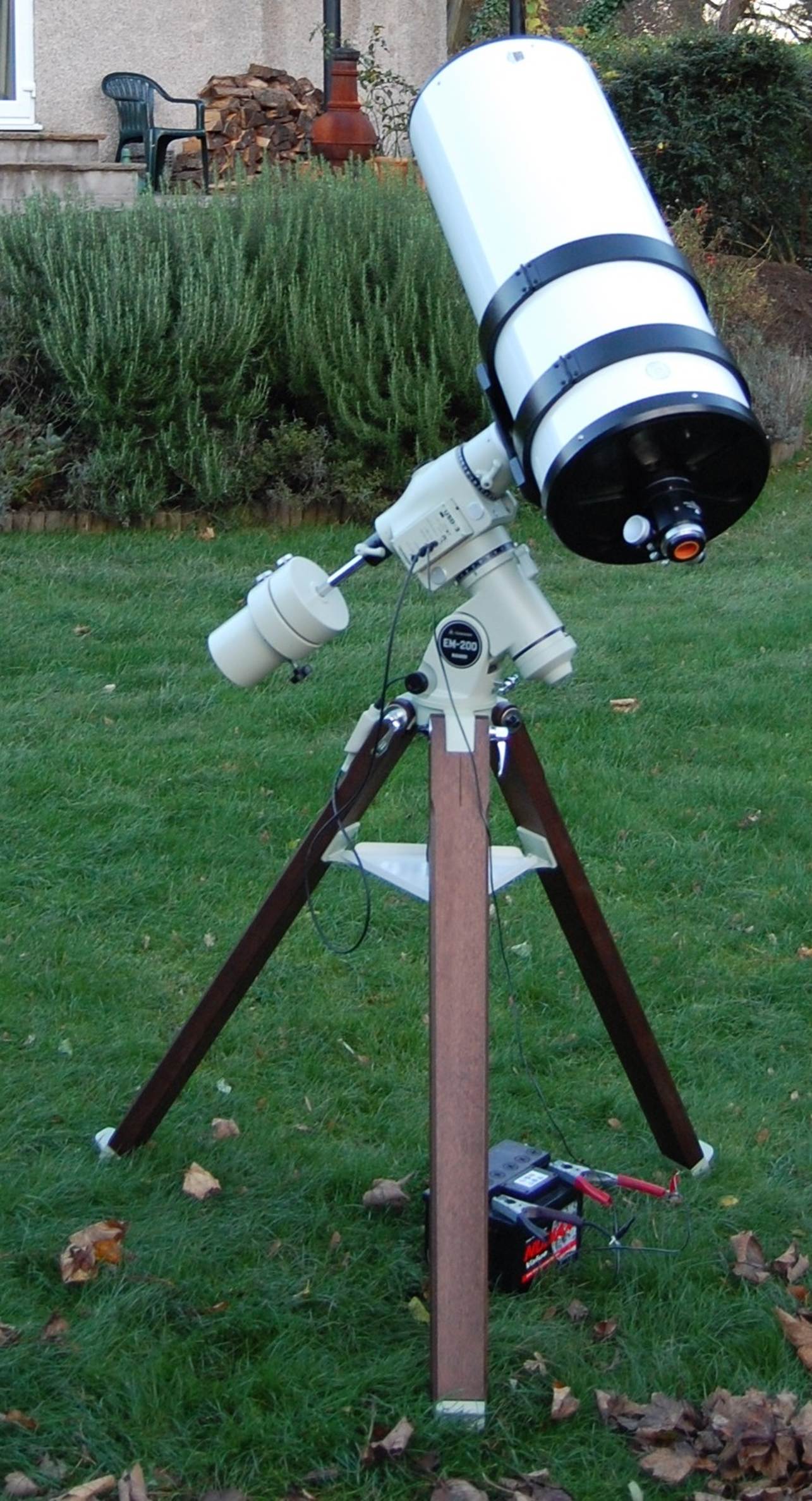
The Big DK overloaded my poor EM200.
Accessories
The scope came with rings – again typical of their
Newtonian rings at that time - that were a bit thin and flexible and not up to
the fine finish of some of the CNC’d parts. I
eventually had some 3rd party rings made that worked much better.
In Use – The Night Sky
General Observing Notes
Televue’s NP127 is all about the view, ahhhh that view... diamond point stars, sharp and detailed
planets, nebulae full of contrast and subtle shading. And in a way this scope
is about the view as well, because it’s just not like that at all.
One basic problem is the field
of view. The lowest power you can get is 65x with a 55mm Plossl
and trying to photograph the Orion Nebula just yields the central section.
Field curvature and off-axis coma isn’t the problem I’d been led to
expect, though, and for smaller DSO’s it makes a good astrograph (just a
pity that’s definitely not what
I bought it for!).
The Moon
On very, very rare (around here, anyway) nights, you could
see the potential. It may not have the crispness of an APO, but showed loads of
Lunar detail using just 20mm and 15mm Plossls –
no fancy eyepieces required.
At its very best on The Moon (and it certainly would be, with
no seeing problems), the detail available can be staggering. I recall a night
when I was able to explore the Hadley Rille region at very high power in a way
I hadn’t before or since, with the Rille looking more like
Schroter’s valley than the usual hairline you have to strain to pick out.
Often, though, the Moon was just a haze of vague
crater-shapes.
Planets
The long focal length gives big bright, planetary views. Even
on a good night, though, you get more light scatter and annoying spider-spikes
than in a refractor. Most of the time, though, planets are just big mushy
bright coloured balls, like Christmas decorations. Why? After all, I bought
this scope for planets.
Is poor optical quality the problem? Emphatically not: the
star test is superb and focus quite snappy given the long focal length. Is it
cool-down? No, the vented back takes good care of that. Collimation? Again no,
the stiff spider and general ruggdness means
collimation has held up perfectly.
Theory suggests that the large central obstruction and
thick-vane spider are a factor, worsening sensitivity to poor seeing; certainly
37% is more than anyone would recommend for a planetary reflector.
Would the big D.K. be better with a smaller obstruction? I believe
so – which adds to my frustration. After all here was a (far from cheap)
scope I’d had custom built and waited years to get ... But what I ended
up with was something optimised as an astrograph when I’d asked for a
specialised planetary scope.
A theoretical side-by-side comparison between the DK and my
7” apochromat (not possible – I don’t have a second large
mount to hand), would have the mirror-scope going deeper but delivering
inferior views in all other respects – just like the comparison between a
C8 and a 4” apochromat I did years ago.
In fact, I could probably have had similar views from a big
SCT with a more convenient focuser (and lower outlay).
Summary
The big DK is both good and bad. On one hand it cools down
fast, holds collimation well and very occasionally delivered the best (and my
friend, a real Lunar buff, agrees) high-power views of Luna ever. For its size
it is light weight compared to the “real thing” (a Mewlon 300) and is of mostly high optical and mechanical
quality.
On the other hand, some of the build quality (mainly the tube
itself) is not the best and it deserves a better focuser (like the Feathertouch I originally asked for).
The real problem, though, has little to do with Orion’s
workmanship. The problem is that Orion built a DK astrograph, when I had wanted
a planetary scope. Just as theory predicts, large Cassegrains with big
obstructions don’t offer great planetary views unless the seeing is near
perfect and where I live that’s very rare.
Perhaps the most telling thing is that when I haven’t
used it for a while, I mount the 12” up in my observatory thinking I must
just have had a run of bad nights, thinking surely I don’t need my
expensive 7” APO when I’ve got a 12” DK with 1/8th
wave optics sitting around gathering dust. Then, a few weeks later, the
7” APO goes back on and stays there for the rest of the season, whilst
the 12” DK goes back to the floor of my study.
Update
In the end I sold it ... as did the guy I sold it too ... and
the guy he sold it to. I believe it has now gone to the U.S., where steadier
skies may well let it deliver to its potential. Would the Big DK have been
better if they’d built the specialist planetary scope I’d asked
for, rather than the kind of general-purpose astrograph they specialise in?
I’ll never know. Unfortunately, rightly or wrongly, it has really put me
off reflectors.
In a way it all comes down to the
very reasons I set up this website. On paper this scope looked like a winner.
If I lived in New Mexico this could probably have been my only scope; all those
tiddler APOs could have gone on Astromart. Trouble
is, I don’t live in New Mexico and in rainy Northern Europe where I do
live the crummy seeing often means big reflectors with big obstructions deliver
very mediocre views.
Interestingly, Takahashi have pivoted
the two larger Mewlons – the 250 and 300
– into astrographs by fitting them with triplet correctors. Planetary
scopes no longer. Orion’s production DKs are catadioptric astrographs
too.
Orion Optics’s take on a big
Dall-Kirkham is not recommended, especially not for locations with mediocre
seeing. Whether the real thing – a Takahashi Mewlon
300 – would have similar limitations I can’t say, but experience
with a smaller Mewlon suggests it might.