A&M
(LOMO) 80/600
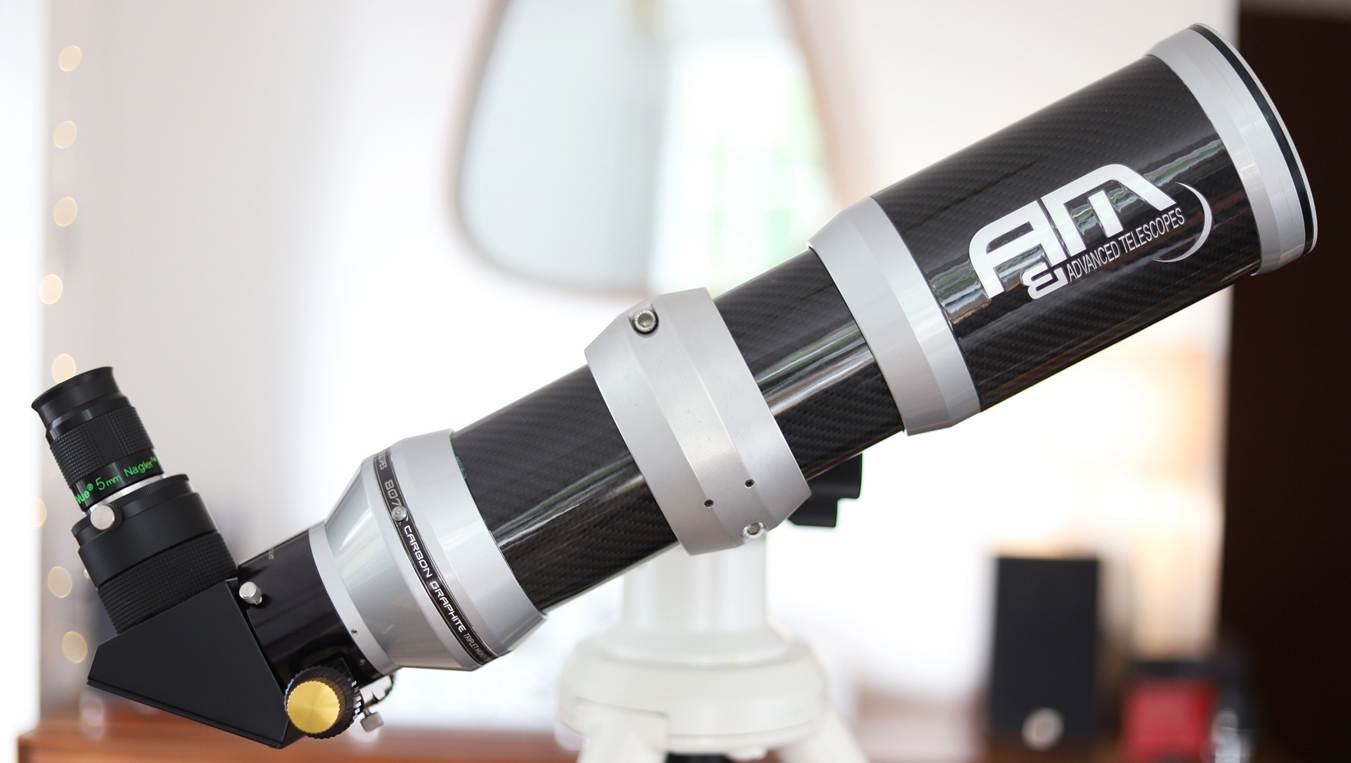
I’m drawn to rare, high-end
scopes and they don’t get much rarer than this one. Even the F6 version of
LOMO’s 80mm triplet that I reviewed here isn’t exactly common. This F7.5
version sold in vanishingly small number twenty years back, because even then
astronomy was turning to imaging. And who wants a premium 80mm triplet
super-APO, anyway (well, me, akshually).
At A Glance
|
Telescope |
A&M
(LOMO) 80/600 |
|
Aperture |
80mm |
|
Focal Length |
600mm |
|
Focal Ratio |
F7.5 |
|
Length |
485mm |
|
Weight |
2.8kg (3.5kg
incl rings & plate) |
Data from me.
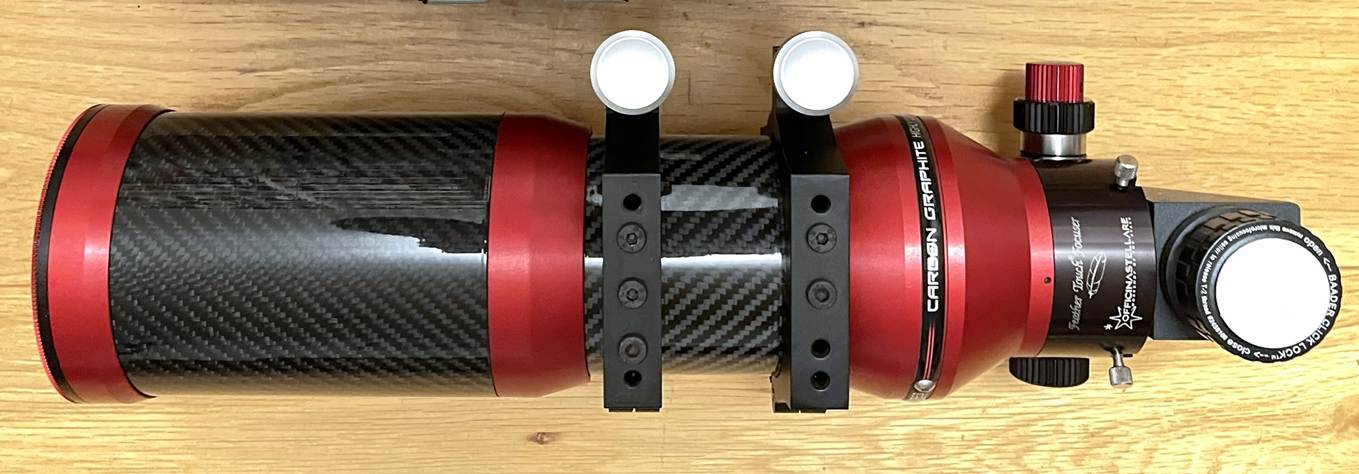
The other 80mm LOMO objective – the 80/480 – was also available
in an A&M carbon tube (image credit: Richard Lynch).
Design and Build
LOMO (Leningrad
Optical-Mechanical Association) is probably best known for their no-frills
Soviet film camera that launched a photography trend of edgy urban images, with
a rough and raw aesthetic. But LOMO was not just a maker of basic film cameras.
Similar to LZOS, it was (and is) a manufacturer of optics from consumer through
research to military.
The only LOMO
objective imported in serious numbers was the 80/480, which is well-regarded
for imaging. The 80/480 was available in OTAs from various brands, including a
William Optics OTA with their single-speed Chinese focuser. The one I reviewed
was in Stellarvue’s rugged but heavy SV80 tube.
A more exotic
version of the 80/480 was produced in a carbon tube by A&M (above). Even
rarer than the F6 version is this F7.5, the 80/600 – a longer focal length version of
the 80/480 optimised for visual use. The A&M carbon tube, made in Italy, is
a beautifully fabricated thing with flawless carbon and very finely engineered
hardware. It would likely have commanded a very premium price.
Optics
Like most consumer
triplets, this is an air-spaced objective with a centre ED crown element
flanked by flints. Exactly which crown and flint glasses I couldn’t find
out. It’s possible that – like LZOS – LOMO melted their own.
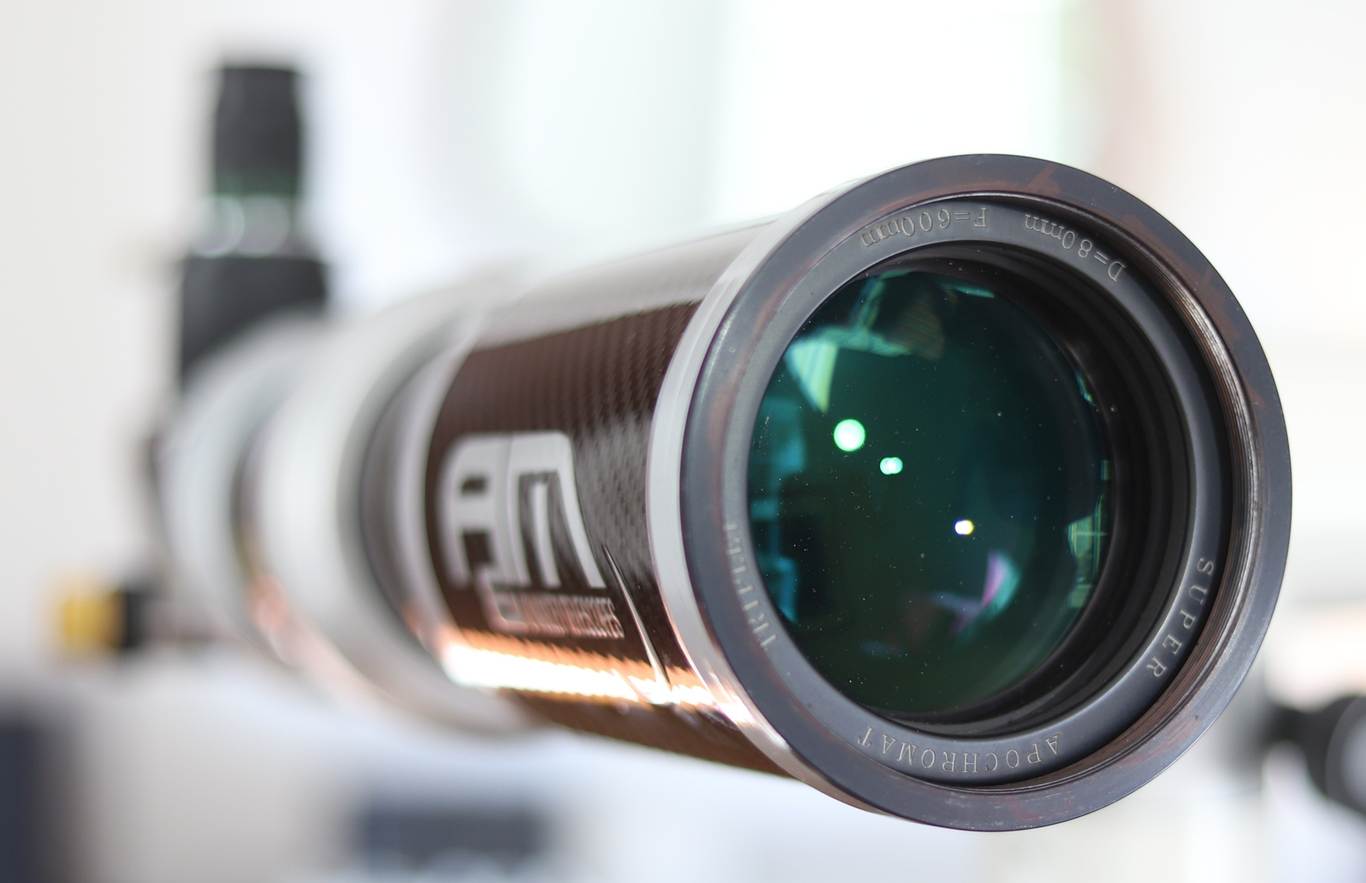
Given the performance, the ED glass is clearly a premium high-fluoride one. The
lens ring says this is a ‘Super Apochromat’ and as we’ll see
that’s true, even more so than the F6 version.
This is not a
simple foil-spaced design. Instead it has thick annular spacers to give air
gaps of a few millimetres between the elements. The spaces allow for improved
correction. More importantly for
imagers (and despite this model’s visual orientation), the annular
spacers offer spike-free star images. The downside is a heavier, more complex
and hence expensive, cell.
Although this is an
older lens, coatings are of the very best, with a modern blue-green hue. The
cell has micro-ring baffles machined in to kill ghosts and stray light.
Overall, this is clearly a cost-no-object design – consistent with its premium
price at the time.
Tube
At 585mm long and a
standard 90mm in diameter, the OTA is about the same size as my AP Stowaway. Despite
the chunky look of the tube hardware, the carbon gives this tube a modest
weight of 2.8kg bare and 3.5kg including the clamshell and Vixen-fit plate
– again, that’s almost identical to the Stowaway.
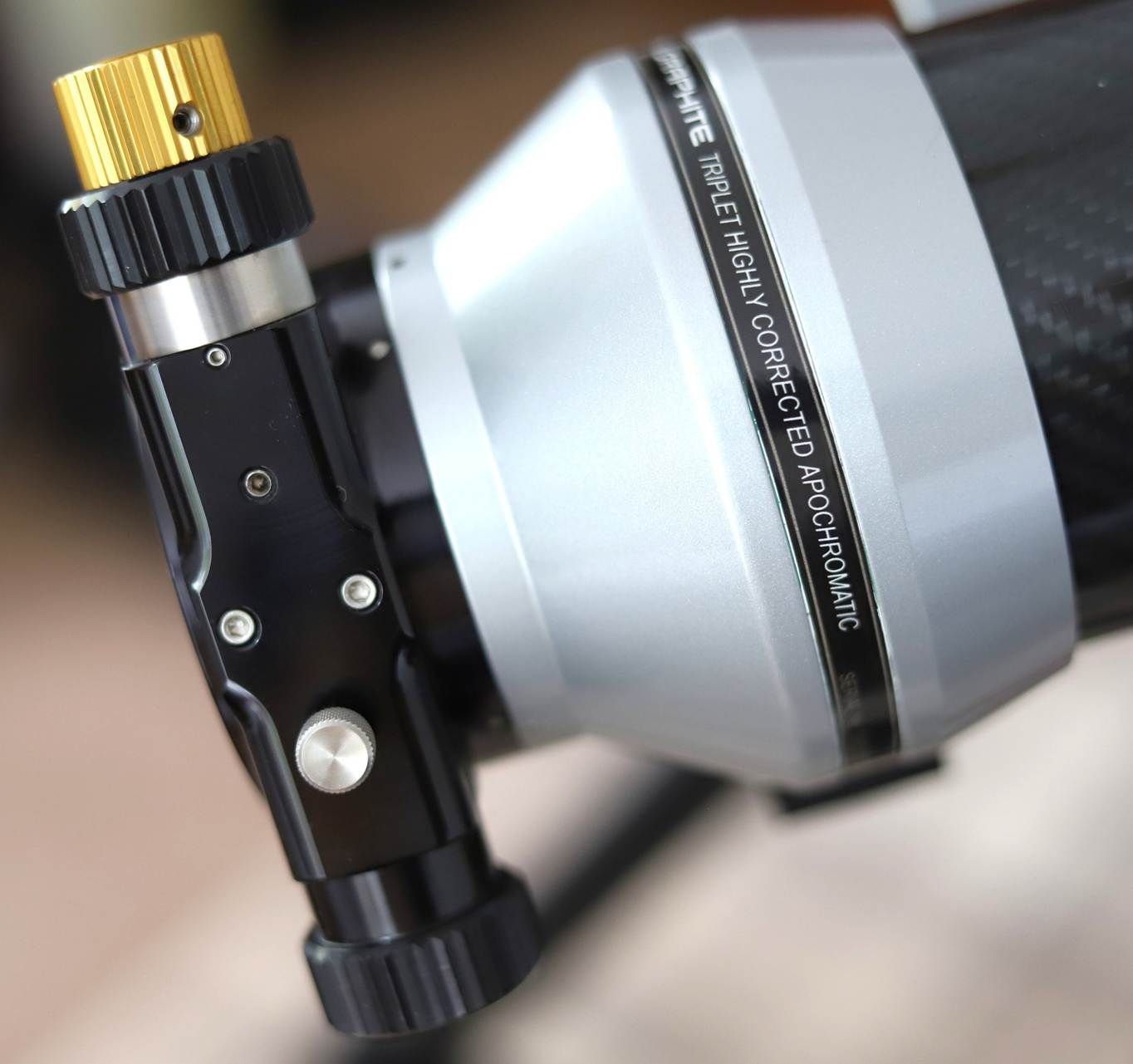
The dew shield
slides on felt and is just the right resistance so doesn’t need a lockscrew. The end-cap threads on Tele Vue style. Again the
machining and finish (a shiny hard-coat metallic like the clam and end rings)
is very good.
The interior is as
carefully finished as the outside. There are three knife-edge baffles to kill
stray light and the tube sections between are lined with the best flocking
material, similar to that found in high-end LZOS OTAs, like my TMB 175.
I was a bit
sceptical about the rather glitzy build and finish, but it is very well done,
looks great in the flesh and works well.
Focuser
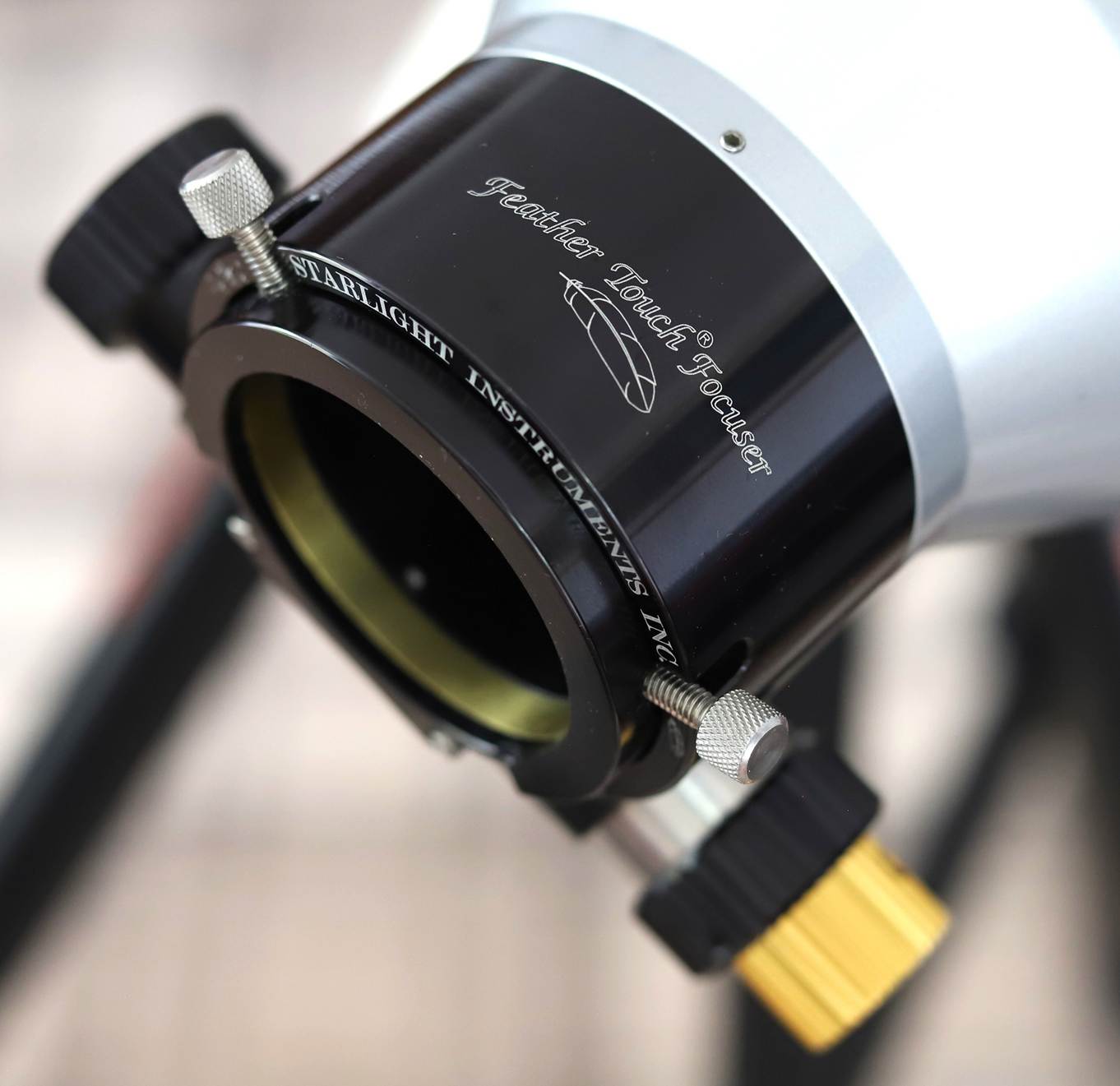
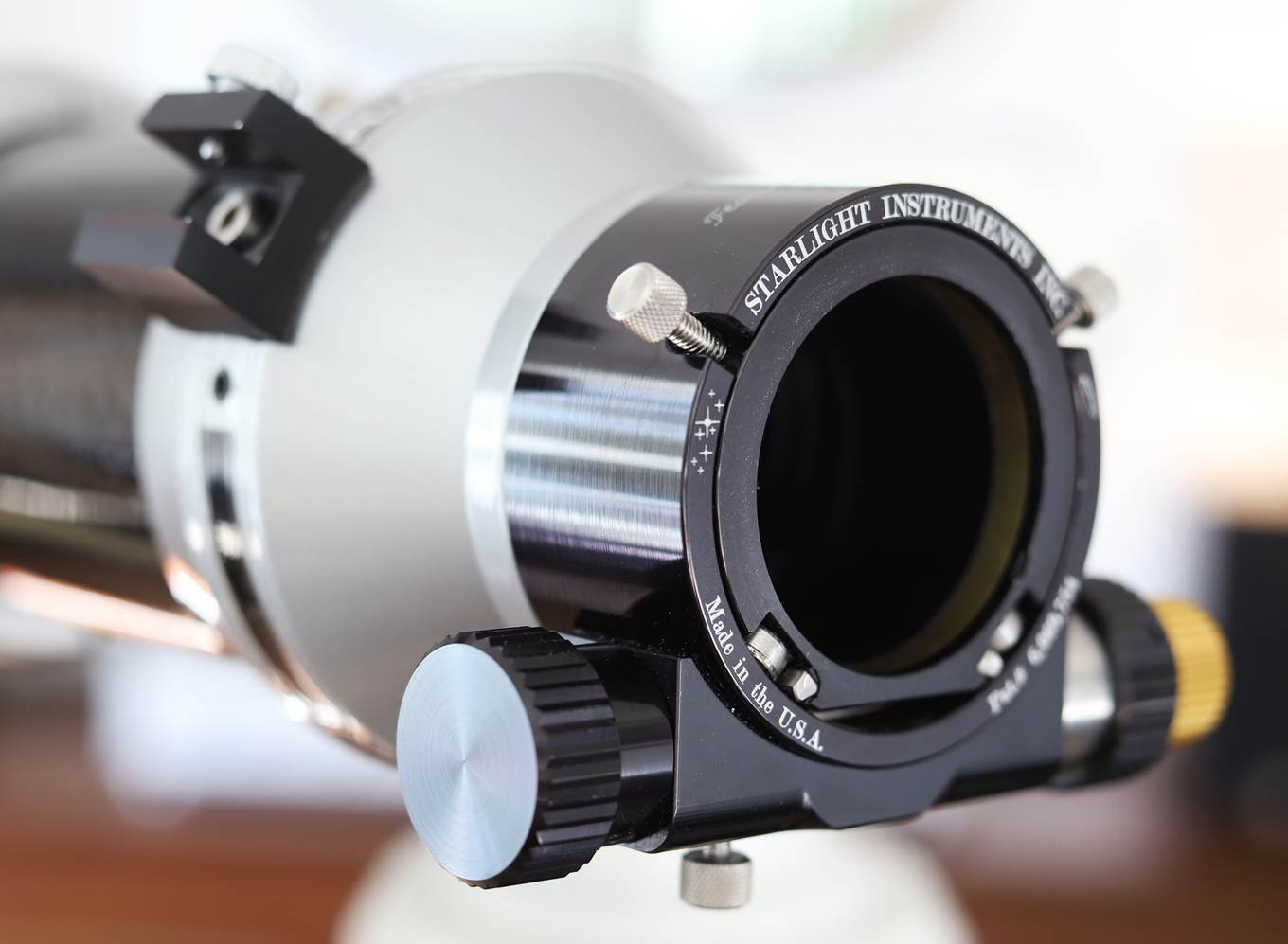
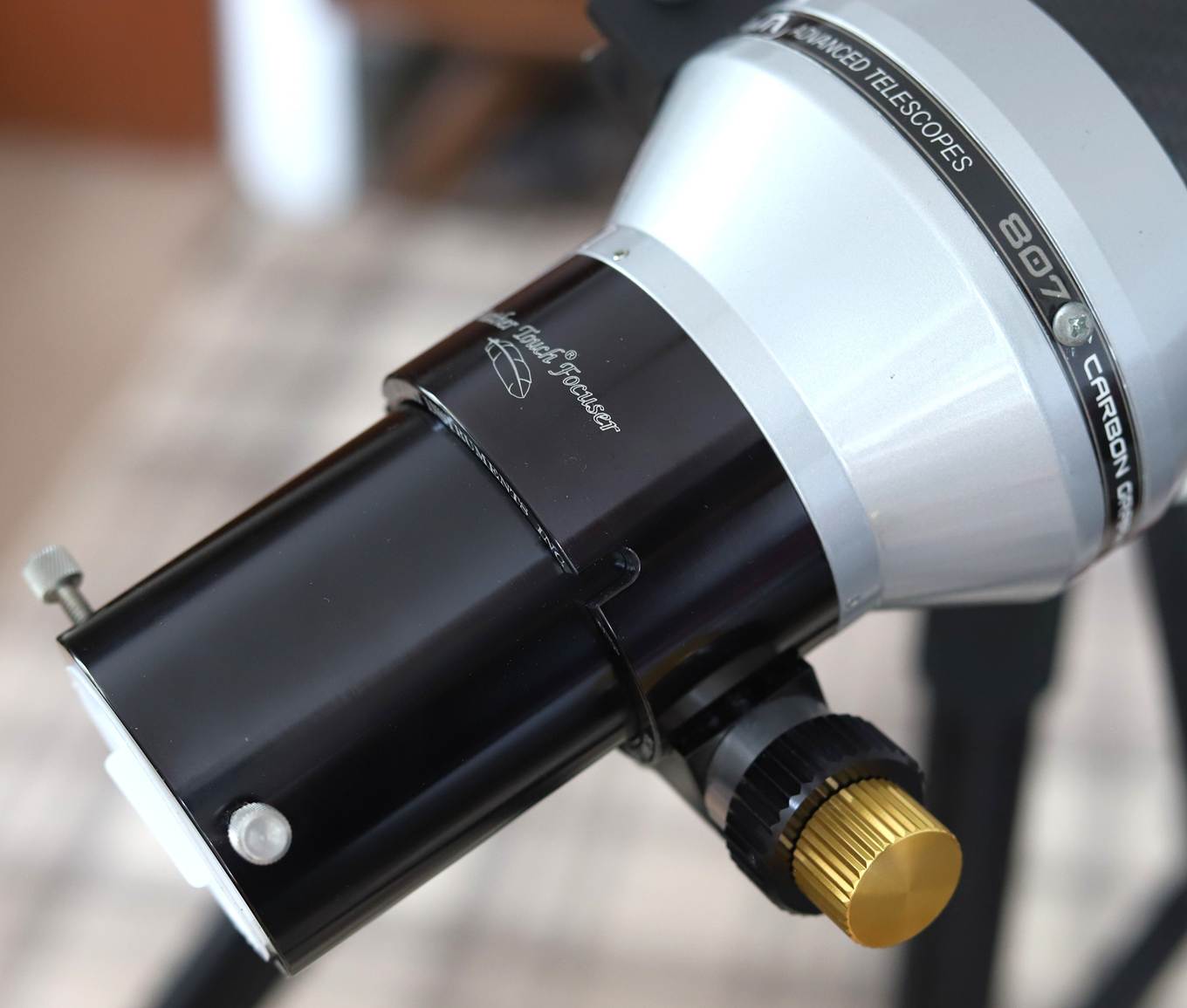
The small
Crayford Feather Touch focuser has a body just 1.375” (35mm) long, with a
2.5” diameter drawtube with a shortish 2.5” (65mm) travel. The
dual-speed pinion on the A&M 80/480 has a matching red anodised fine focus
knob, but here it’s the FT-usual gold. Otherwise, it’s all standard
FT fare – parts milled from hard stainless, with very fine fit and glossy
anodised finish.
The only way
to alter tension is with a locking thumbscrew underneath, so one of the larger
rack-and-pinion models might be preferable for imaging. But for visual use
these little Crayfords are even smoother and more
precise than the rack and pinion Feathertouch models –
perhaps the best focuser available for visual.
The focuser
is mounted on a custom-made adapter that interfaces with the carbon tube and is
typical of A&M OTAs.
Mounting
The tube is
obviously a bit longer and heavier than the very compact F6 model. Still, it is
light, compact and so stable on all but the smallest mount, alt-az or equatorial. I mostly used it on a Vixen SX2 which
proved very stable at high powers. The APZ mount had more vibes, but still
worked well. The lighter Porta mount worked fine too, but vibes were more of a
problem – just as they were for Tele Vue’s TV-85.
Accessories
This is mainly a
planetary/lunar specialist, so you will likely want some quality eyepieces to
get the best from it. Options include modern designs like Takahashi’s TOE
range, older favourites like Orthoscopics, or barlowed
Tele Vue Plossls. For the Moon, I like a wider field
for that porthole effect and still rate Naglers and Ethos highly.
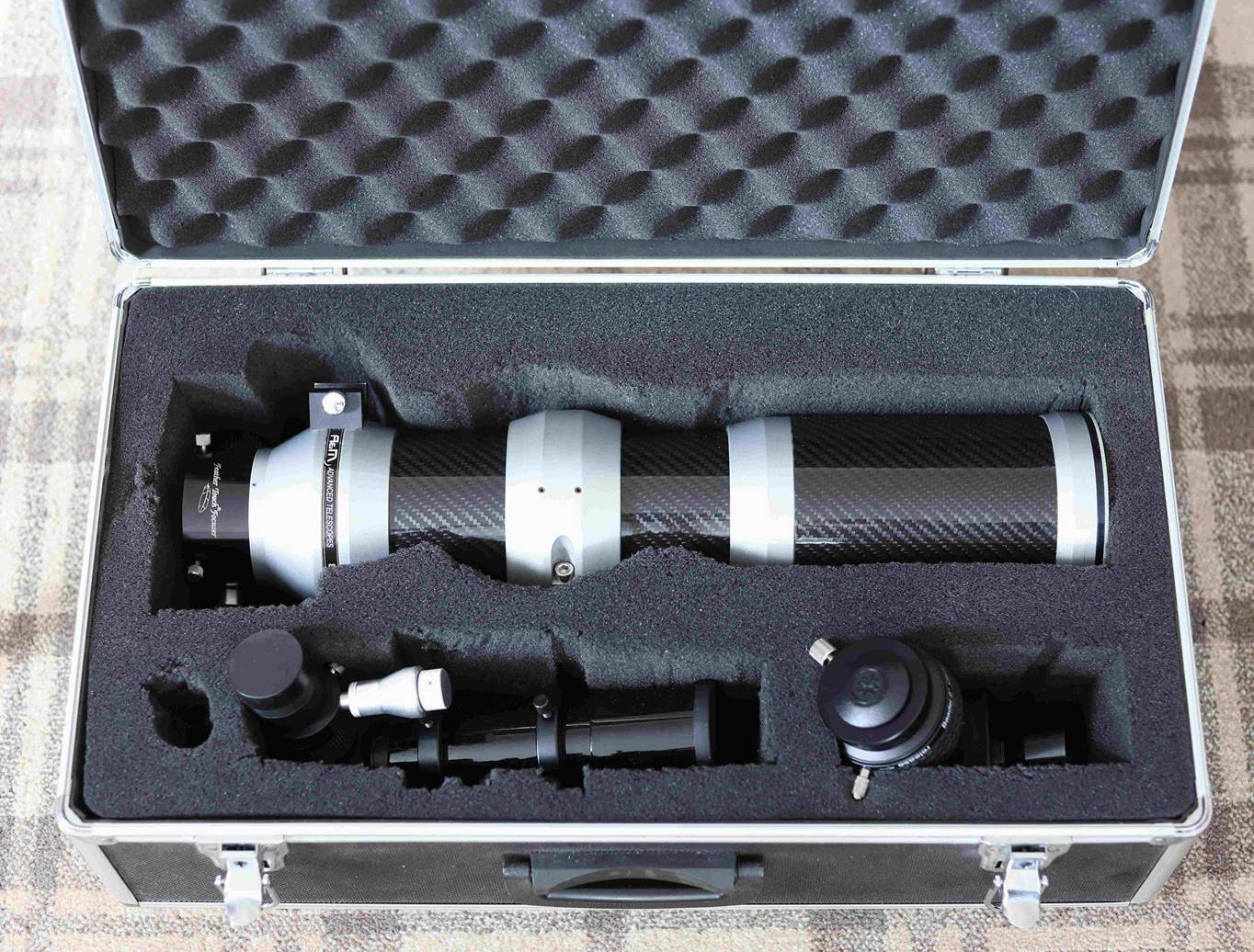
Personally, I
don’t bother with a finder at this focal length – I just use a
low-power eyepiece, but this scope does come with a bracket and finder, all
packed into a nice aluminium case.
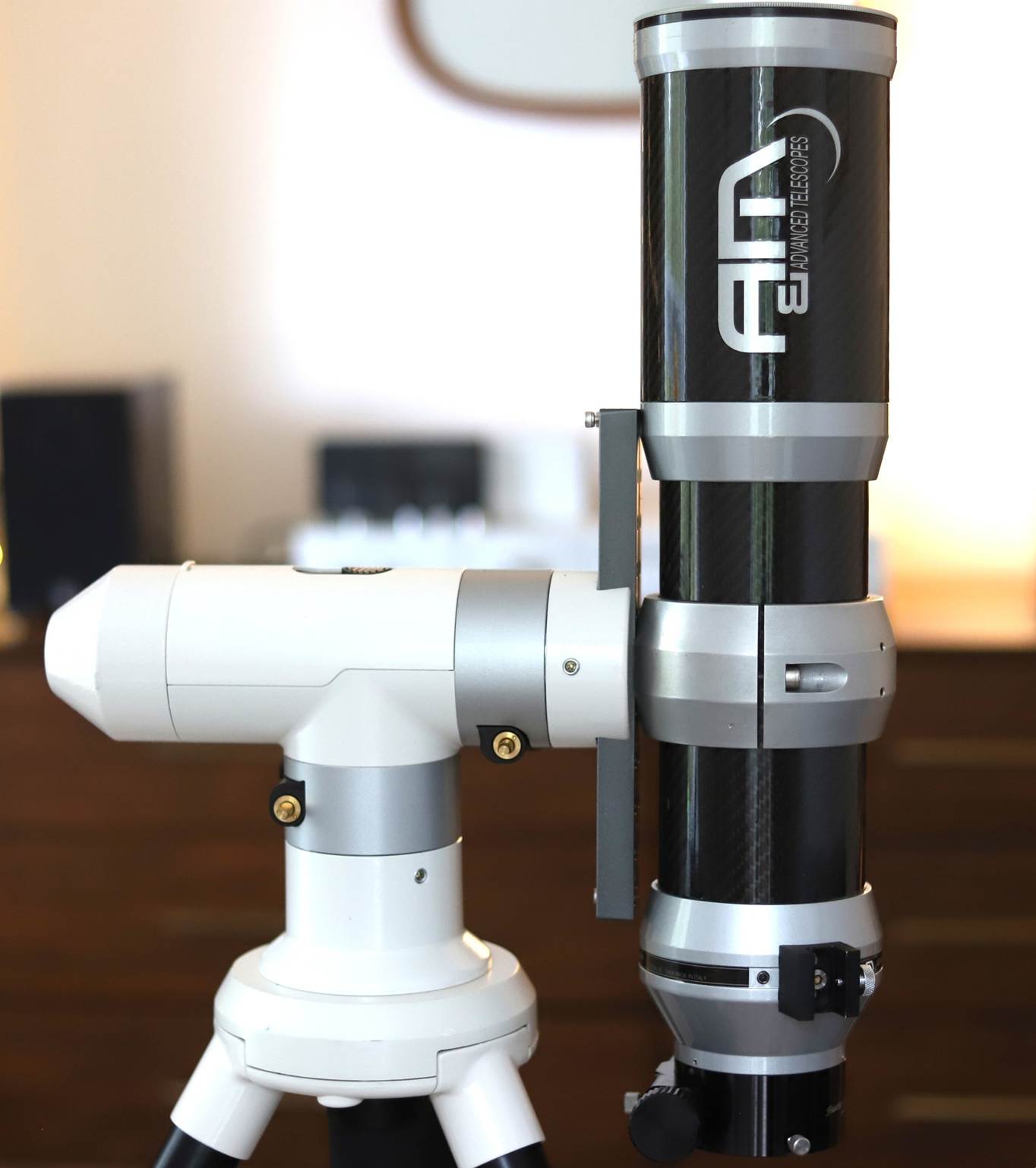
Mounted on a Vixen APZ with dewshield retracted.
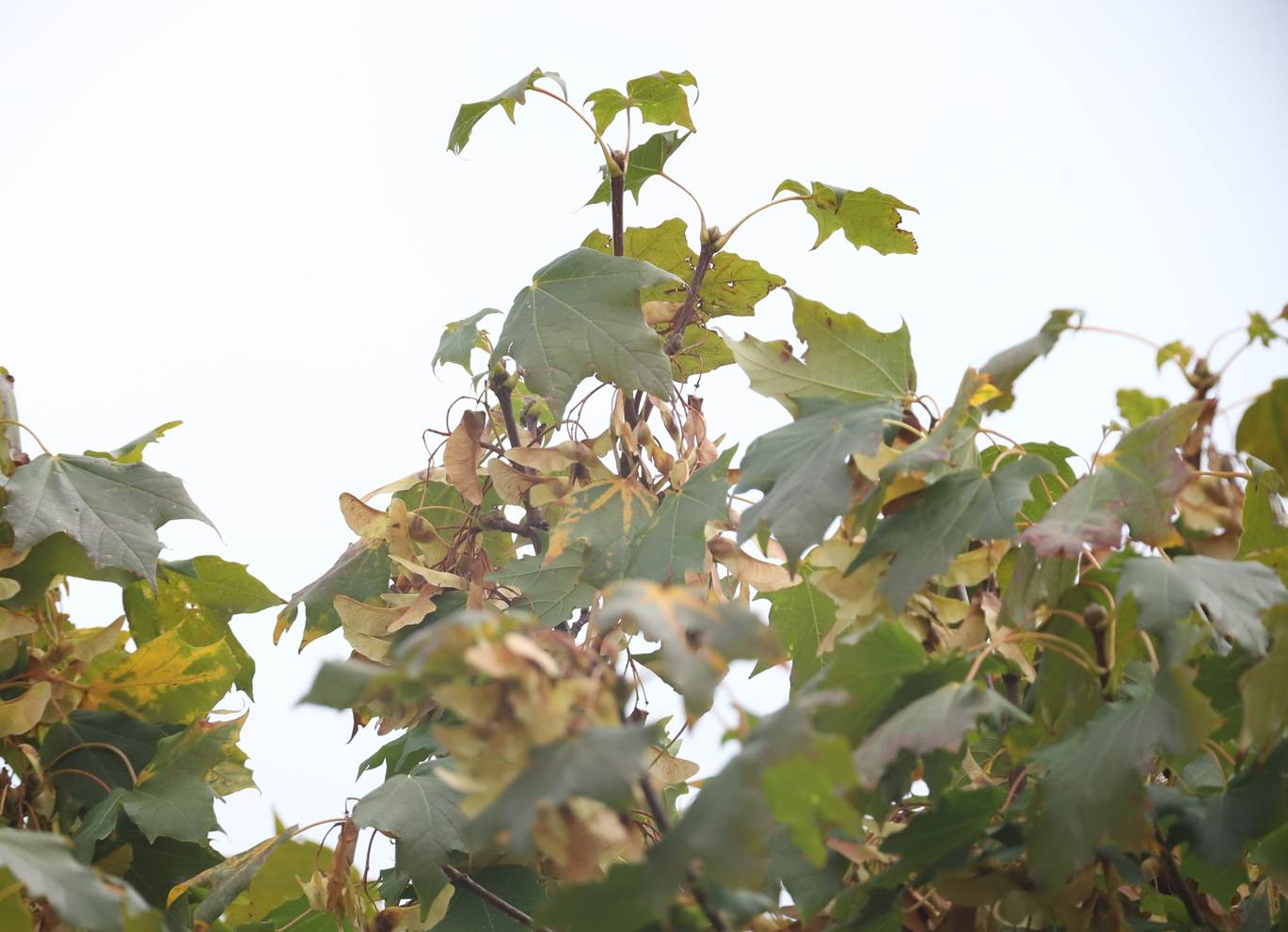
100% crop of branches at prime focus, over-exposed 1 f-stop: no false colour, excellent sharpness.
In Use – Daytime
The A&M 80/600
is compact enough to use as a daytime spotter. It gives astonishingly crisp and
fringe-free views, even at powers well above spotting-scope norms. You can see
this in my usual test of viewing branches at 100x magnification against a
bright sky. This revealed no visible false colour at all – a feat only a
select few refractors achieve and proving the ‘Super Apochromat’ on
the lens ring.
Views of migrating
ducks and geese far out on the sparkling waters of the bay are very similar to
the Stowaway. The improved correction over a fast ED doublet like the TV-76 is
very noticeable.
Emphasising the
visual perfection, prime focus images of silhouetted branches are among the
sharpest I have taken, with no false colour and minimal light bleed.
Impressive.
In Use – Astrophotography
‘Planetary’
refractors of 100m aperture and above often have an F8 or F9 focal ratio to get
near perfect correction. At 80mm aperture, F7.5 is sufficient and makes the
80/600 more useful for imaging (the difference between F7.5 and F8 is
significant). I got some very decent deep-sky frames with excellent star images
(thanks to those annular spacers) and a fairly flat field. Lunar images are
superb for the modest image scale.
The little Crayford
supported my consumer camera fine, but for a heavy imaging rig you would need a
focuser with a wider drawtube, longer body and drawtube clamps.
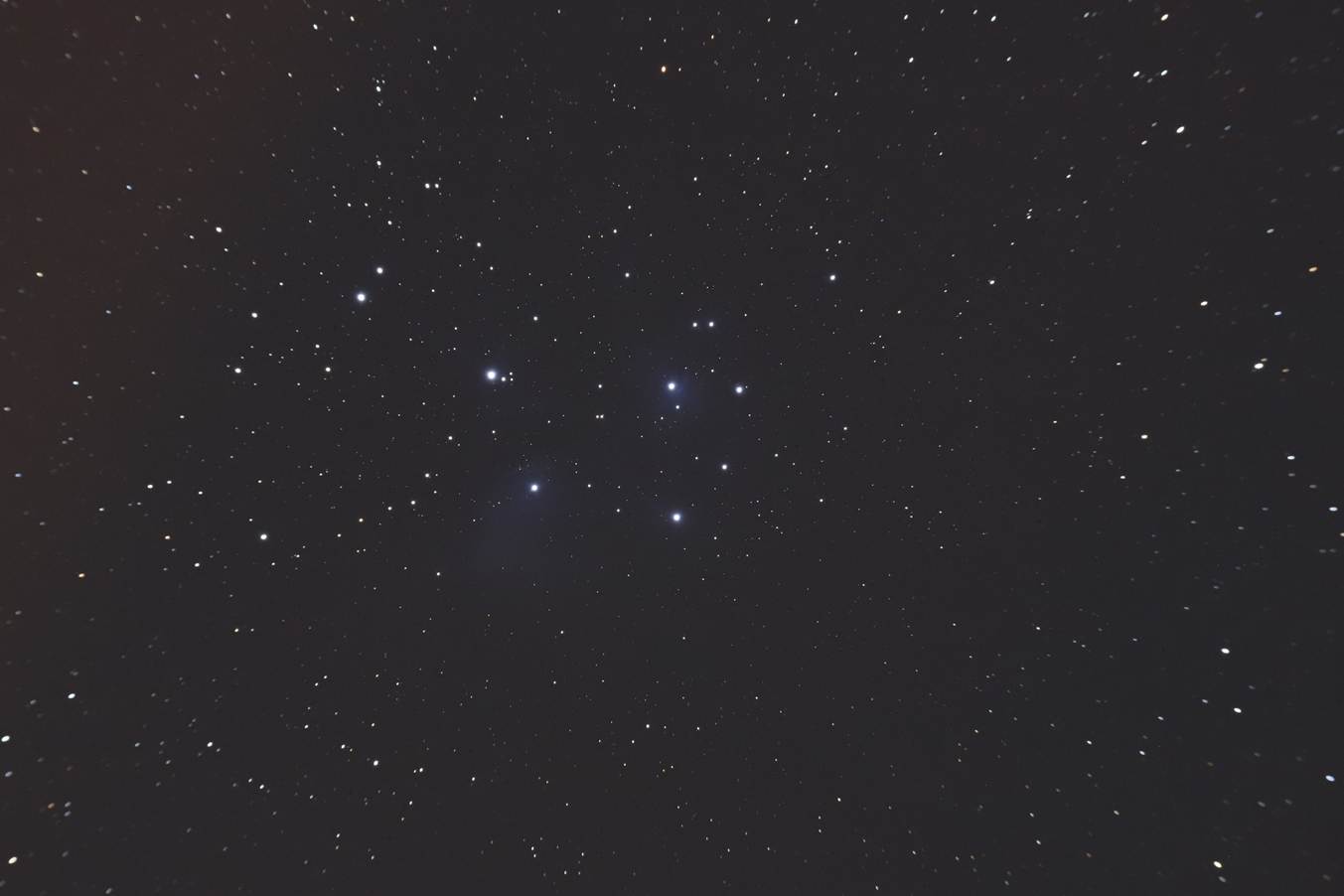
M45: 45s ISO 3200 Canon EOS 6D MkII at F7.5 prime.
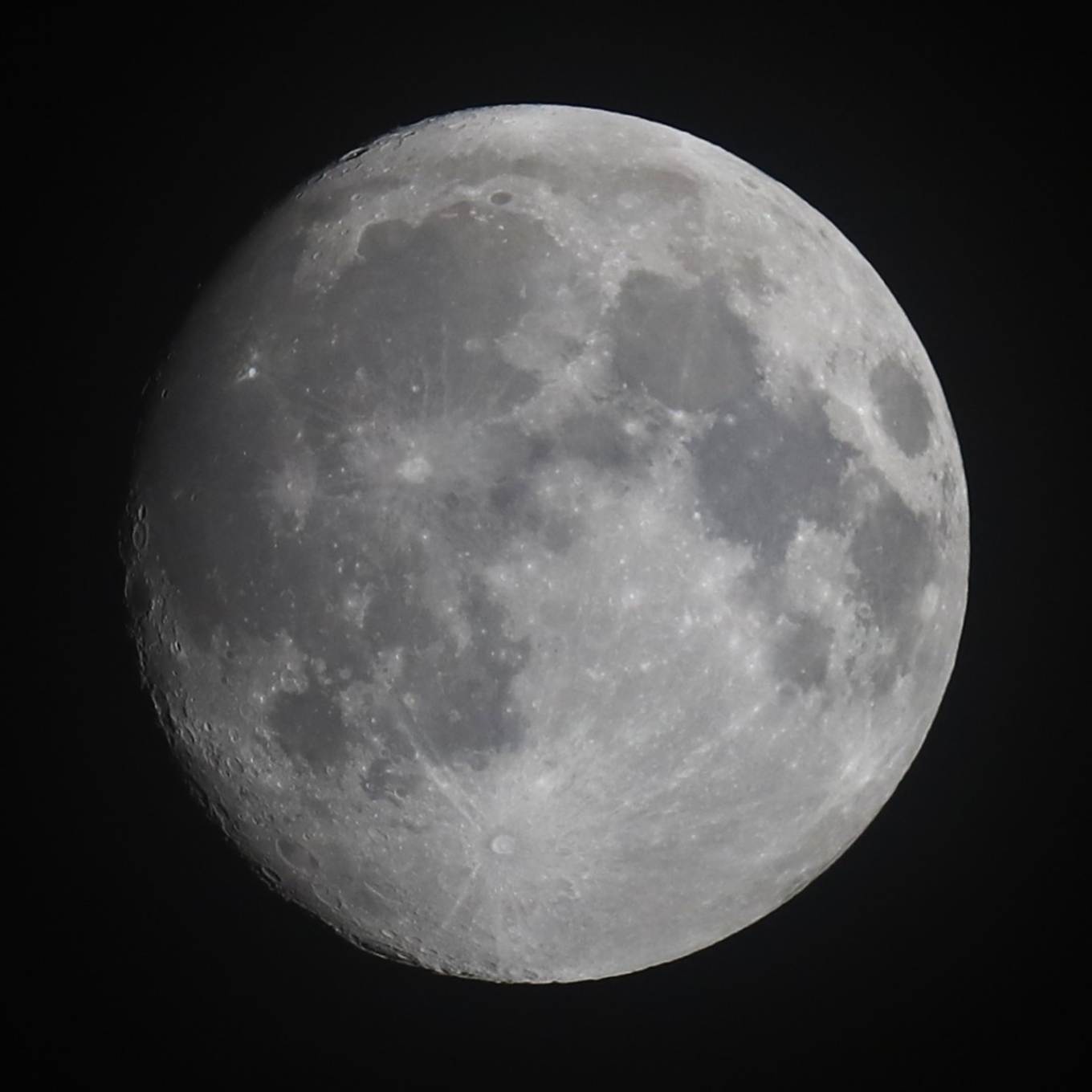
The Moon: 1/500th ISO 800 Canon EOS 6D MkII at F7.5 prime.
In Use – Observing the Night Sky
General Observing Notes
The ultra precise,
smooth Crayford focuser gave no image shift, even at 130x – typical for
these focusers and among the very best. But the short travel means it doesn’t come to focus with all eyepieces when
using a 2” diagonal.
Cool Down
Despite being a
triplet with wide air spaces, cool down seems only a little slower than a TV-85
or Takahashi FC-76. Triplet cooldown here just isn’t the issue it can be
at larger apertures.
Star Test
The star test was perfect, even at 150x: identical rings
inside and out, with very even illumination and a very sharp outer ring. A perfect
in-focus diffraction pattern too. An almost imperceptible (and entirely
academic) trace of colour in the out of focus blur on Rigel was the only false
colour I noticed in the star test.
The Moon
I couldn’t spot any false colour on the limb when focusing through at 130x. I noted modest levels of scatter from the bright limb, but perhaps a little more than a modern fluorite doublet (the only optical characteristic where triplets sometimes underperform doublets).
The 80/600 gave me crisp and perfectly monochrome views of a 13-day Moon: Dawn breaking over large crater Bailly (an 18th c. French astronomer, in case you were wondering); Pythagoras not far from Plato, with his central peak and sharp outer cliffs, right on the terminator. Hevelius and Cavalerius on the western margin of Oceanus Procellarum, near to which Luna 9 unfurled its metal petals after the first ever soft landing.
Jupiter
Jovian views at
high altitude and in good seeing were ultra sharp, with lots of detail at 150x,
using the 4mm setting of a Nagler zoom. The polar hoods were very distinct, with
fine gradations in their hue. I noted the equatorial belt between the NEB and
SEB, where the festoons drag and converge on the equator. The view remained perfectly
sharp at 170x with 3.5mm Nagler, but revealed no more detail.
Just the faintest
trace of gold edging the out-of-focus planet at high power lets you know this
isn’t (quite) as perfect as a TMB 130 F9, but otherwise the 80/600 is up
there with the most colour-free triplet refractors.
Saturn
High in the autumn
sky, and at almost 20 arcsecs across near opposition, Saturn was mesmerising
through the 80/600 on a night of fine seeing. Even though the rings
aren’t fully open yet, the Cassini division was easy and the rings stood
out from the pale equatorial regions of the planet in 3D. The whale-grey polar
hoods were strongly contrasted with the equator and I was able to spot several
moons.
As usual, my 5mm TMB
Monocentric had a barely-perceptible edge over everything else in sharpness and
contrast.
Deep Sky
The fine star
images and high contrast gave exceptional views of brighter DSOs, like the Ring
Nebula in Lyra and the clusters in Auriga. I got a vast split of the Double Double at 130x, with exceptionally sharp Airy disks and
very faint diffraction rings for this aperture, loads of black space between.
A&M 80/600 vs AP Stowaway
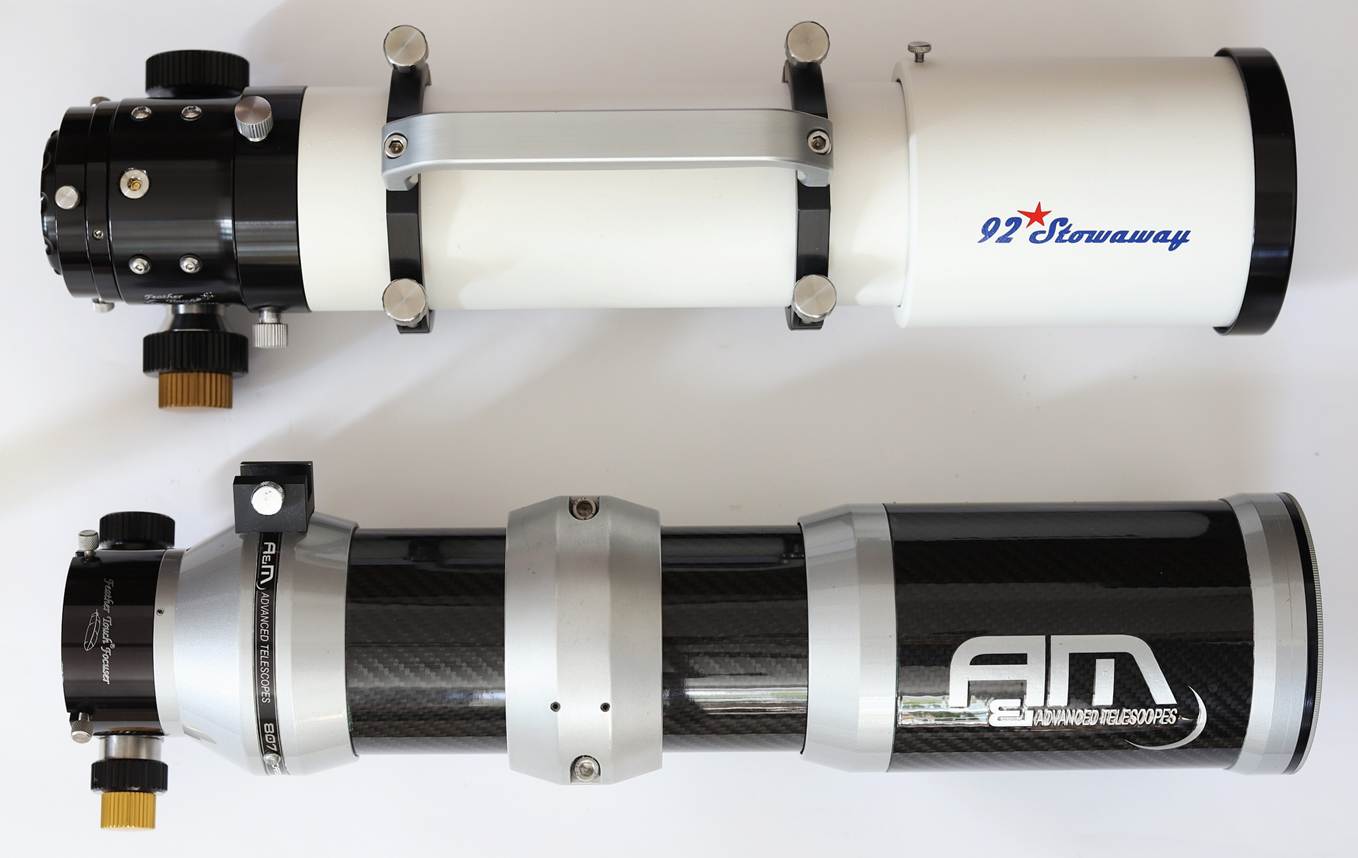
A&M 80/600 alongside 92mm AP Stowaway, both with dew-shields retracted.
Astro
Physics’ current Stowaway is probably the best scope available in this
size range and it makes an interesting comparison with the A&M 80/600
– not least because they are of similar size and weight.
These scopes are both
air-spaced ED triplets and they do give a similar view. The faster (F6) version
of the LOMO showed a trace more false colour in the out-of-focus blur than the
Stowaway, but the F7.5 version on review here eliminates that difference
– both it and the Stowaway are *almost* perfectly corrected for visual.
As with the F6
version, I actually prefer the action of the Crayford focuser
on the 80/600 to the larger rack-and-pinion Feather Touch on the Stowaway. The
Crayford feels smoother, more precise and slightly less ‘rubbery’.
But overall, the larger focuser is more useful – it handles heavier loads
and has more travel to work with a range of eyepieces and diagonal. The rotator
on the bigger FT is very useful too.
The
Stowaway’s extra aperture is most noticeable on deep sky (e.g. structure
in M42). The greater image scale and resolution is discernible, but not hugely
significant, on Jupiter and Saturn.
For imaging, violet
bloat is again quite similar, even though the Stowaway is faster (possibly
thanks to a modern premium crown). The Stowaway corrects the outer field almost
as well, despite its faster focal ratio.
Identical in weight,
they are almost the same length too.
Summary
The LOMO 80/600 more
than holds its own against modern triplets. Designed for visual use, and giving
very fine views of solar system targets, at F7.5 it still performs well for
imaging. Those annular spacers make for clean star images – a great
feature for deep sky, whether enjoying a star field, or taking frames to stack.
You would need a bigger
focuser if imaging with a filter wheel, or heavy camera. If not, I just love
the small FT Crayford – one of the very best for visual, unless you use a
heavy binoviewer.
Downsides? Despite
its beautiful and unusual appearance, some say that carbon tubes cool more
slowly, but if so I didn’t notice!
The LOMO 80/600 is very
rare and scarcity adds value. Given its premium features and crossover appeal,
it’s still expensive for a used scope today. But for a similar price, I
would still choose it over a modern Chinese triplet.
A big thanks to
Richard for the kind loan of his scope (loaners allow me to review wonderful
classic scopes like this one)!
The LOMO 80/600 remains one of the finest scopes
in this class. It
works superbly for visual use on the Moon and planets, but turns its hand to
imaging too.