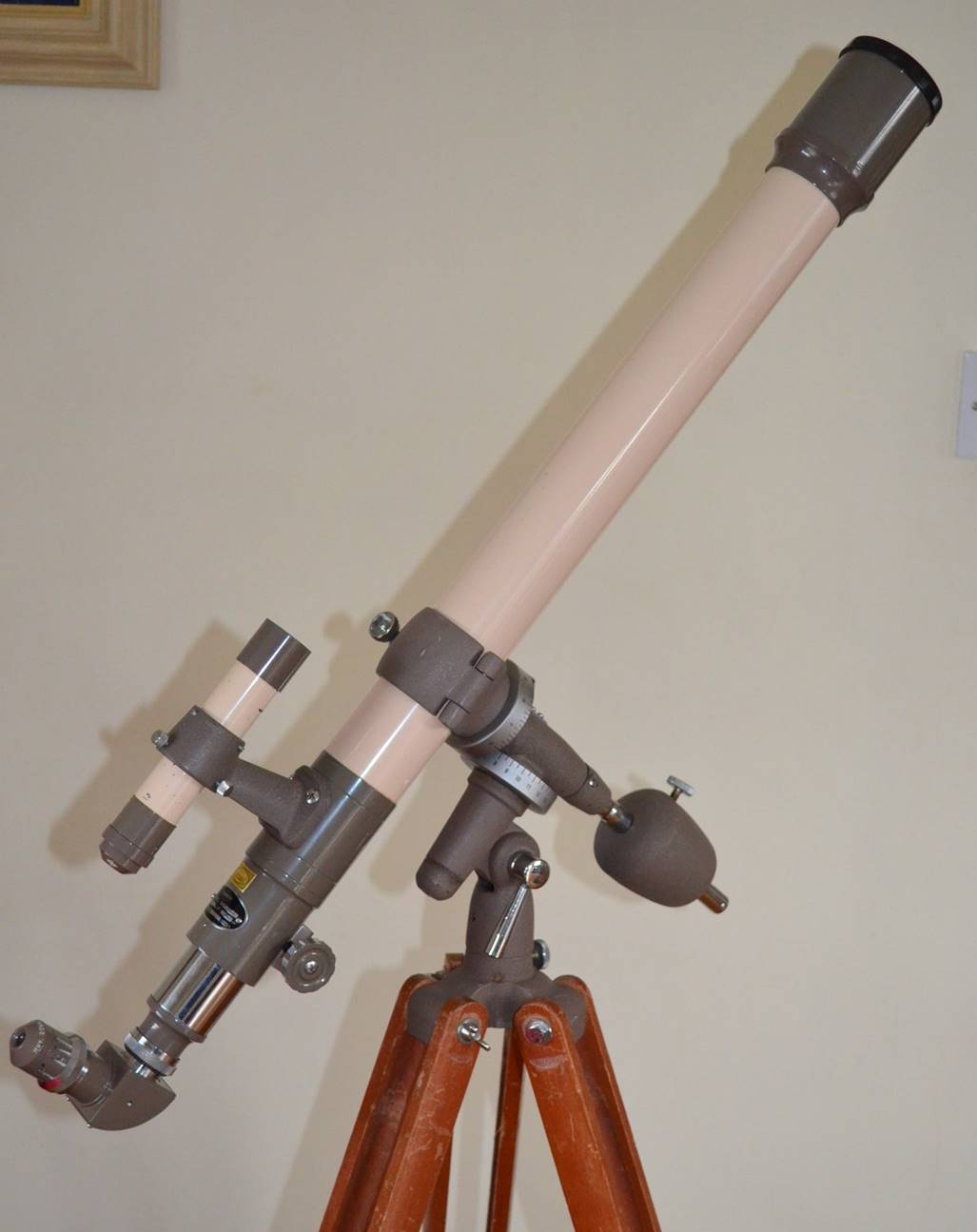
Swift
Model 838 Review
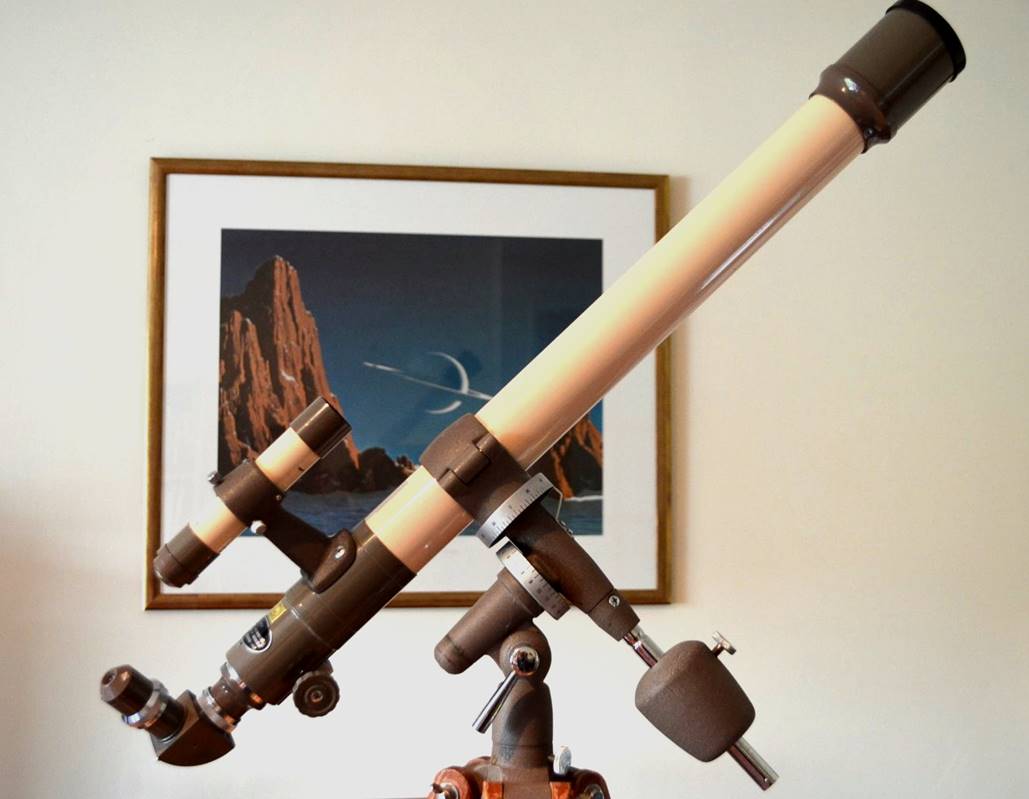
Swift
Model 838 with ‘Saturn seen From Titan’
by Chesley Bonestell, from The Conquest of Space, 1958.
If
the past is another country, then the Sixties seem now like a strange mix of
France and Vanuatu – simultaneously close and familiar, distant and
exotic. I remember the Sixties - just. But it’s becoming
increasingly hard for me to imagine a time when TV was
black-and-white, the local car showroom had Morris Minors in the window and a
calculator had cogs. Then again, in the Sixties men went to the Moon, something
beyond us today. Back to the future.
Having
said that, though the Space Race was delivering feats we couldn’t match
now, we knew remarkably little about the Solar System in the early Sixties;
really astoundingly little. Even by mid-decade – my Swift Model 838 was
made in 1964 – planetary science had scarcely advanced from the days of
Percival Lowell. So when some lucky girl or boy first unwrapped the Swift Model
838’s deluxe wooden box, for birthday or Christmas, then breathlessly
assembled it and turned it on the Moon or a bright planet, they were looking at
terra incognita.
Again,
this is hard to imagine now. Children grow up with alien worlds delivered in HD
CGI with every SciFi blockbuster. But a
child looking through the Swift from the back-garden of a suburban semi in 1964
could look at real alien worlds and imagine … almost anything. Just a
decade later that would no longer be possible. It is this, I think, that imbues
late ‘50s and early ‘60s telescopes like the Swift with a unique
aura: one foot in the fantasy-world of Lowell, the other in the space age.
Back
to 1964
To
set the Swift model 838 in context, I want to reach back to the mindscape of
its new owner in 1964.
Fifty
five years ago the Moon landings were years away, the first successful flyby of
Mars ditto. But to say that makes the early Sixties sound modern. In fact, in
1964 most of what we knew about the solar system came from a few professional
astronomers glued to the eyepieces of half a dozen or so large refractors, just
as it had for a century.
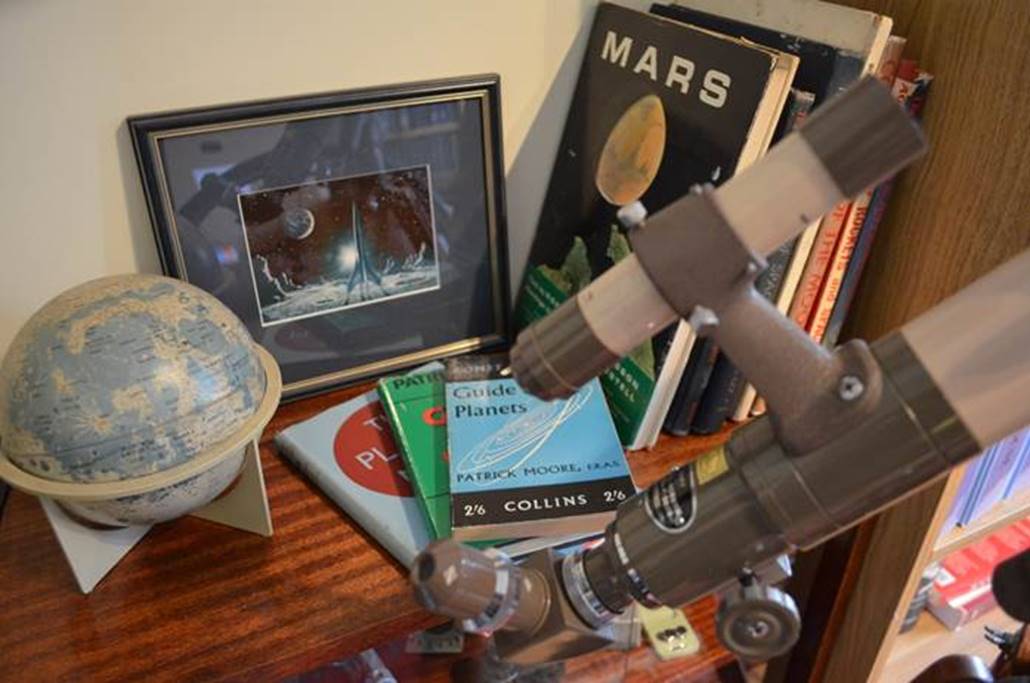
To
get a sense of what might have been in the Swift 838’s first
owner’s mind, when they first set their new telescope on the sky,
I’ve assembled some quotes from contemporary titles our new astronomer
might have had on his or her bookshelf:
Mercury
“One
hemisphere is perpetually scorched by the solar rays, while no gleams of
sunlight ever penetrate to the far side.” (Guide to the Planets, Moore,
1957)
Venus
“when
we are confronted with two such dissimilar pictures, each supported by leading
astronomers, our lack of positive knowledge is brought home to us. On the
dustbowl theory, life of any kind … is obviously impossible; on the ocean
theory … there is a loophole for very primitive marine creatures.”
(Guide to the Planets, Moore, 1957)
The
Moon
“As the dividing line between
light and darkness, the terminator, advances, the floor of Plato grows darker.
What happens in the crater of Plato? Evaporation of moisture forming a
light-absorbing mist? Or just melting ice?” (The Conquest of Space, Ley
and Bonestell, 1958)
Mars
“On the morning of June 4, 1956,
I was on Mount Wilson working with the 60-inch reflector … A
magnification of 700 made it seem as if Mars were being viewed from a spaceship
… The bright red regions were covered with innumerable irregular blue
lines, like veins running through some mineral. Several minutes passed before
it occurred to me these markings must be canals.” (Mars, Richardson,
1965).
“… we are forced back to
the most obvious theory of all – that the dark areas of Mars are made up
of something that lives and grows.” (Guide to Mars, Moore, 1960)
Jupiter
“… these disturbances may
be volcanic … All this amid cliffs of permanent ice rising from a sea of
temporarily liquid ammonia!” (The Conquest of Space, Ley
and Bonestell, 1958)
Seen in the context of such fanciful
ideas, a little scope like the Swift was, in 1964, a vehicle for fantasy and
exploration in a way no telescope can be today. But can we get a sense of this from using the
Swift fifty years on? Here I aim to find out.
At
A Glance
|
Telescope |
1964 Swift Model 838 |
|
Aperture |
50 mm |
|
Focal Length |
700 mm |
|
Focal Ratio |
F 14 |
|
Length |
700 mm |
|
Weight |
~6 Kg including mount |
Data
from Me.
What’s
in the Box?
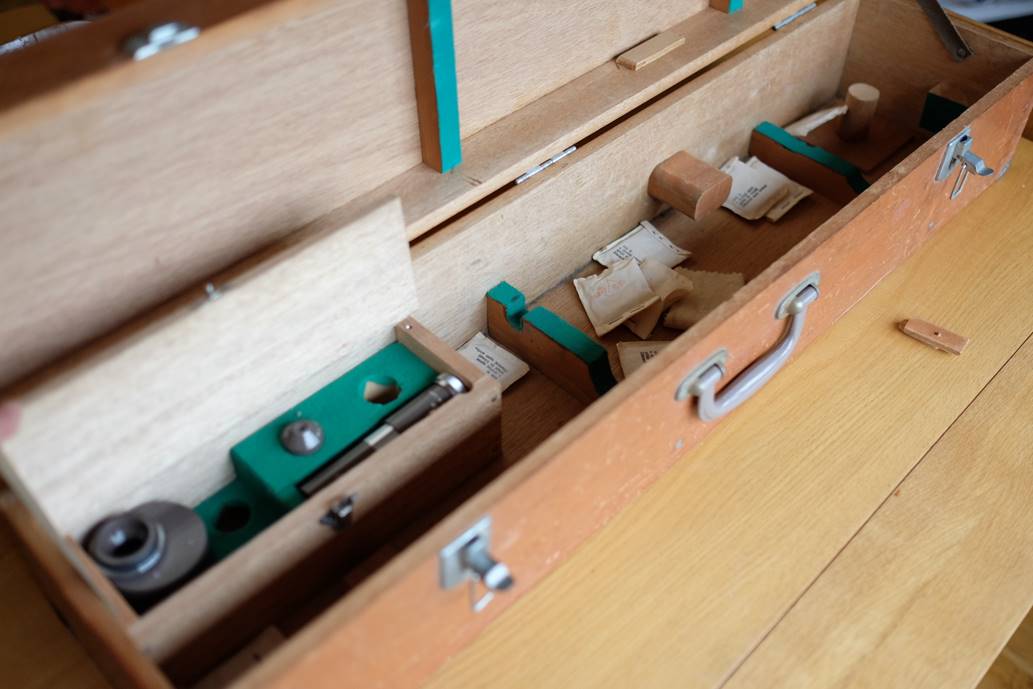
Like
many period refractors, the Swift comes in a very nicely made wooden box, lined
with green felt and with a place for every accessory.
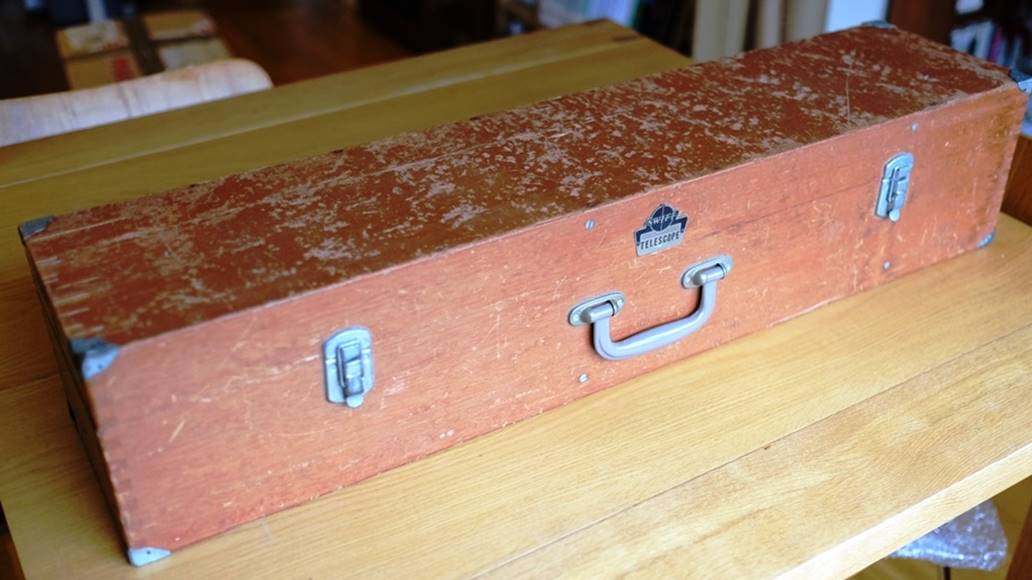
Design
and Build
Many
have speculated on the fact that the Swift has styling and build cues that
remind of Takahashi. I will be discussing this attractive idea later, but here
I’ll just note that Swift weren’t alone. Check out a Sixties Carton
or Prinz and you will find much the same thing.
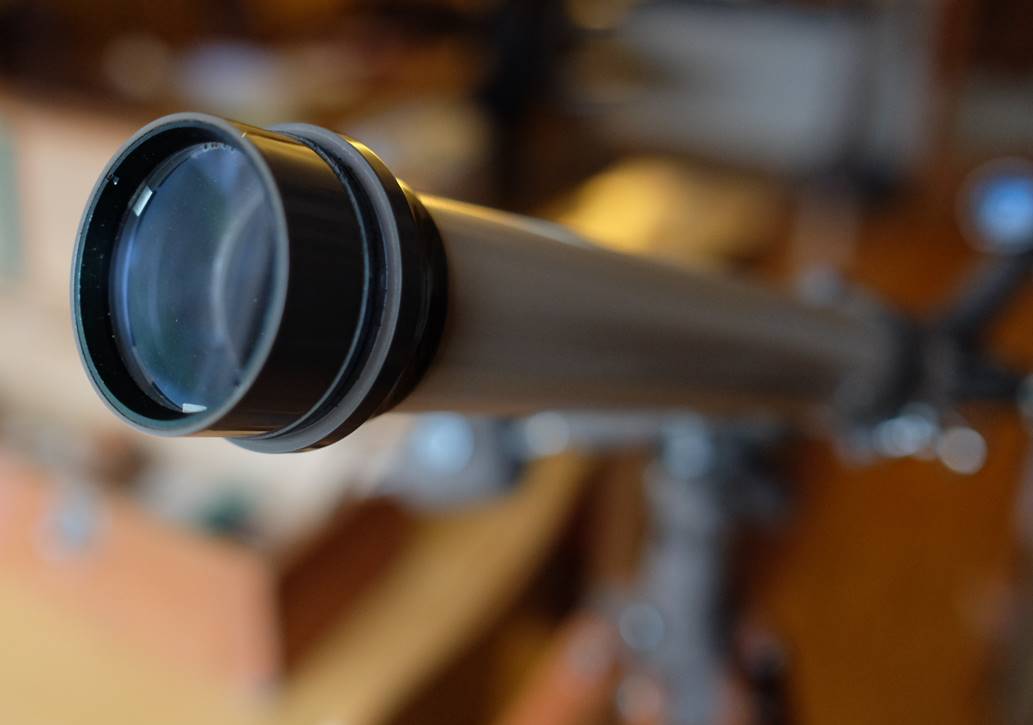
In
any event, the Swift is beautifully put together, but as we will see (unlike a
similarly elegant Unitron) those good looks also translate to performance.
Optics
The
Swift Model 838 has a 50mm (2 inch) air-spaced Fraunhofer achromatic
objective of 700mm focal length ( F14 ). Given that F15 is generally the focal
ratio used for much larger achromats, we can expect that the little Swift
wouldn’t be troubled by false colour. I won’t pre-empt the test,
but in practice the view through the Model 838 is as free from chromatic
aberration as many ‘apochromats’.
The
lens is held in place in a simple cell with a lock ring; collimation is fixed.
The coatings are good quality single coatings and from what I can tell from the
reflections, all surfaces are coated. The elements are separated by simple foil
spacers like most small doublets. All in all, the Swift’s lens is
superficially no different from other small achromats of the day.
Tube
If
the optics look like any other, the Swift OTA is unique. External build quality
is very high: in a different class from say a Tasco of the time.
Instead of being held together by push-fit and screws, both the objective cell
and focuser attach by threads, as does the dew-shield. Everything is made from
metal and the castings are of high quality.
Whether
or not you like the trademark Swift finish, in two shades of coffee, it is
thick, smooth and has endured extremely well. The brochure proudly
boasts ‘enamel finishes are triple coated and oven baked’. Whilst
the OTA is gloss, the mount parts are crinkle-coated in a similar colour; so is
the finder mount, which looks odd on the gloss tube, but is original. That
crinkle coating is very period – I recall my father’s late Fifties
typewriter was covered in it.
Focuser
The
focuser is perhaps where the Swift departs most obviously from the run of the
mill ‘60s Japanese refractor – it is beautifully designed and
engineered. Everything about it, from the thick draw-tube chrome, to the
accurately machined, wide cross-cut rack is of the highest quality pre-CNC
could deliver. It is much closer to a Tele Vue or Takahashi focuser
than to a Tasco.
The
focuser looks good, but it is also smooth, accurate and free from play or image
shift. Shine a torch in the end and you can see that it’s baffled and
flat-black painted too. The visual back is a twist ring like a Takahashi with
no set screws and it too works very well; it is even inscribed with which
direction to turn to tighten or loosen it. It’s a design
that Baader have re-discovered with their ‘click-lock’
accessories. If Swift were doing this in 1964, why do we still
suffer the set-screw?
The
draw-tube has a remarkably long travel. Why? Japanese observers like to use
their refractors straight through and the Swift allows this without an
extension tube.
On
top of the focuser is a proudly embossed name plate with a serial number, again
reminiscent of a Takahashi
The
only down-side to the focuser is that it takes only 0.965 accessories.
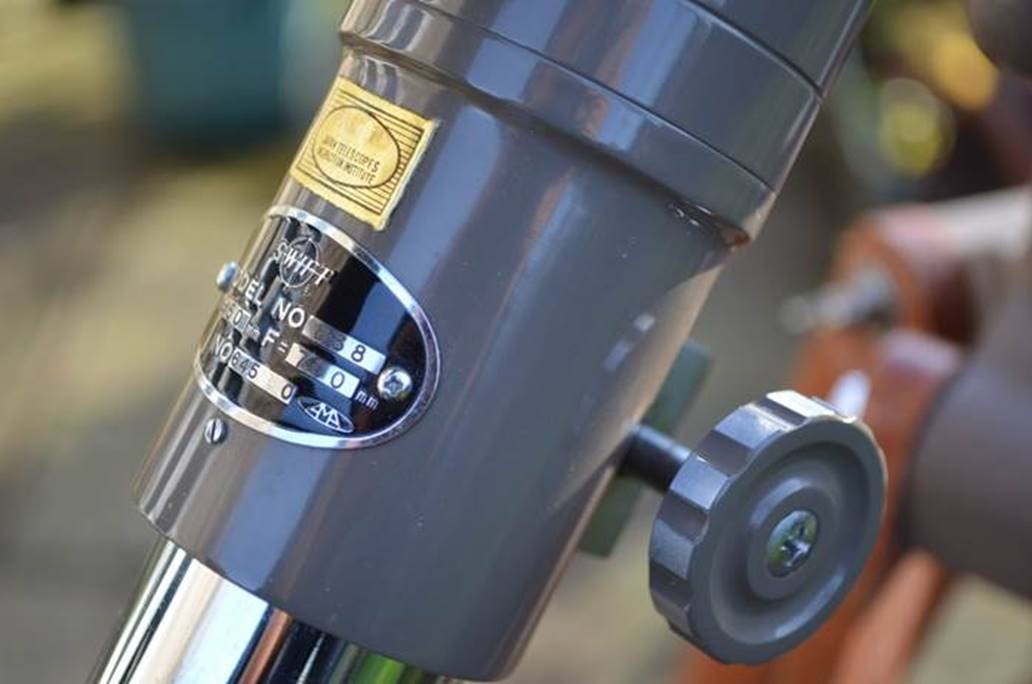
Name
plate, serial number and cast wheels – like a Takahashi?
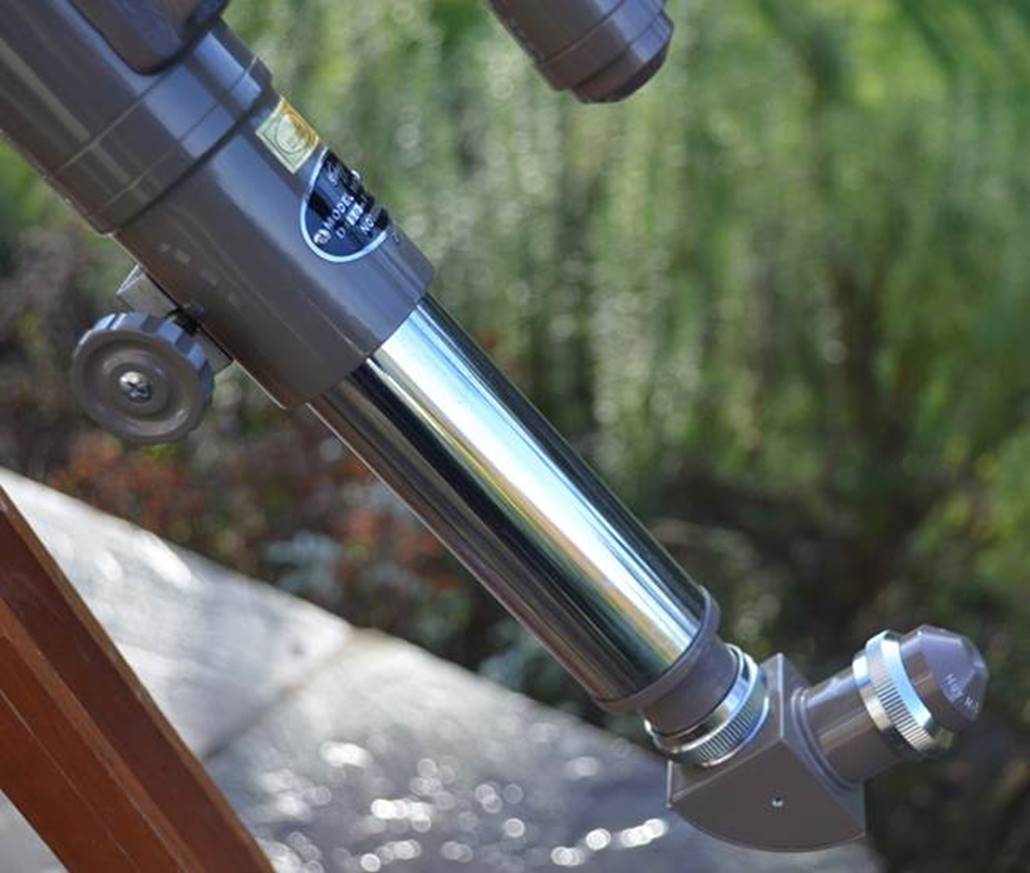
Swift
focuser at full travel – an extension is never needed.
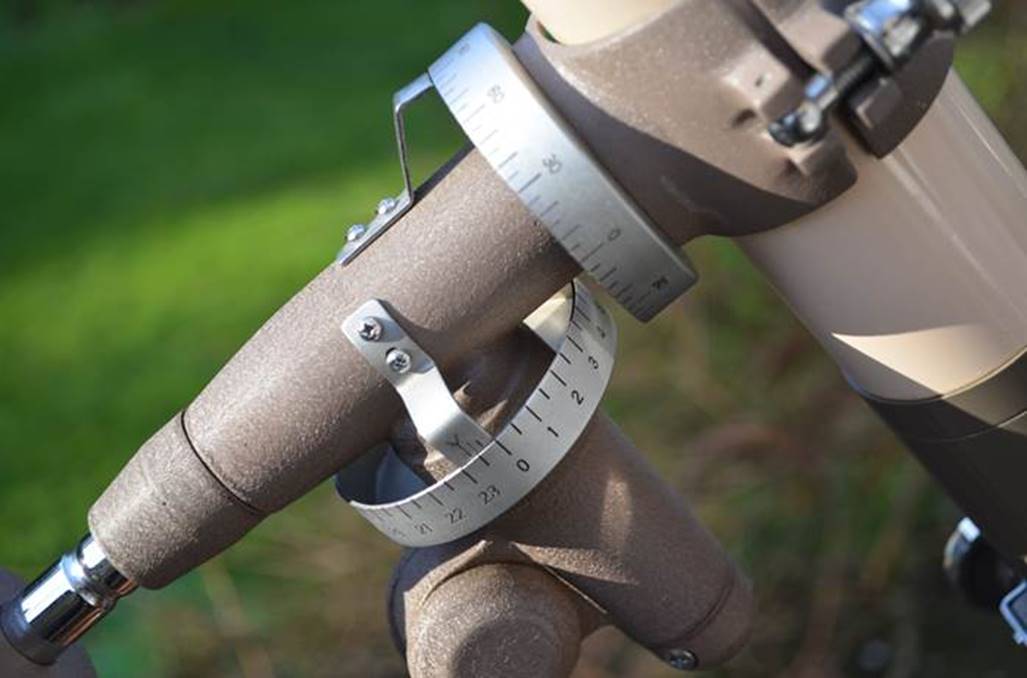
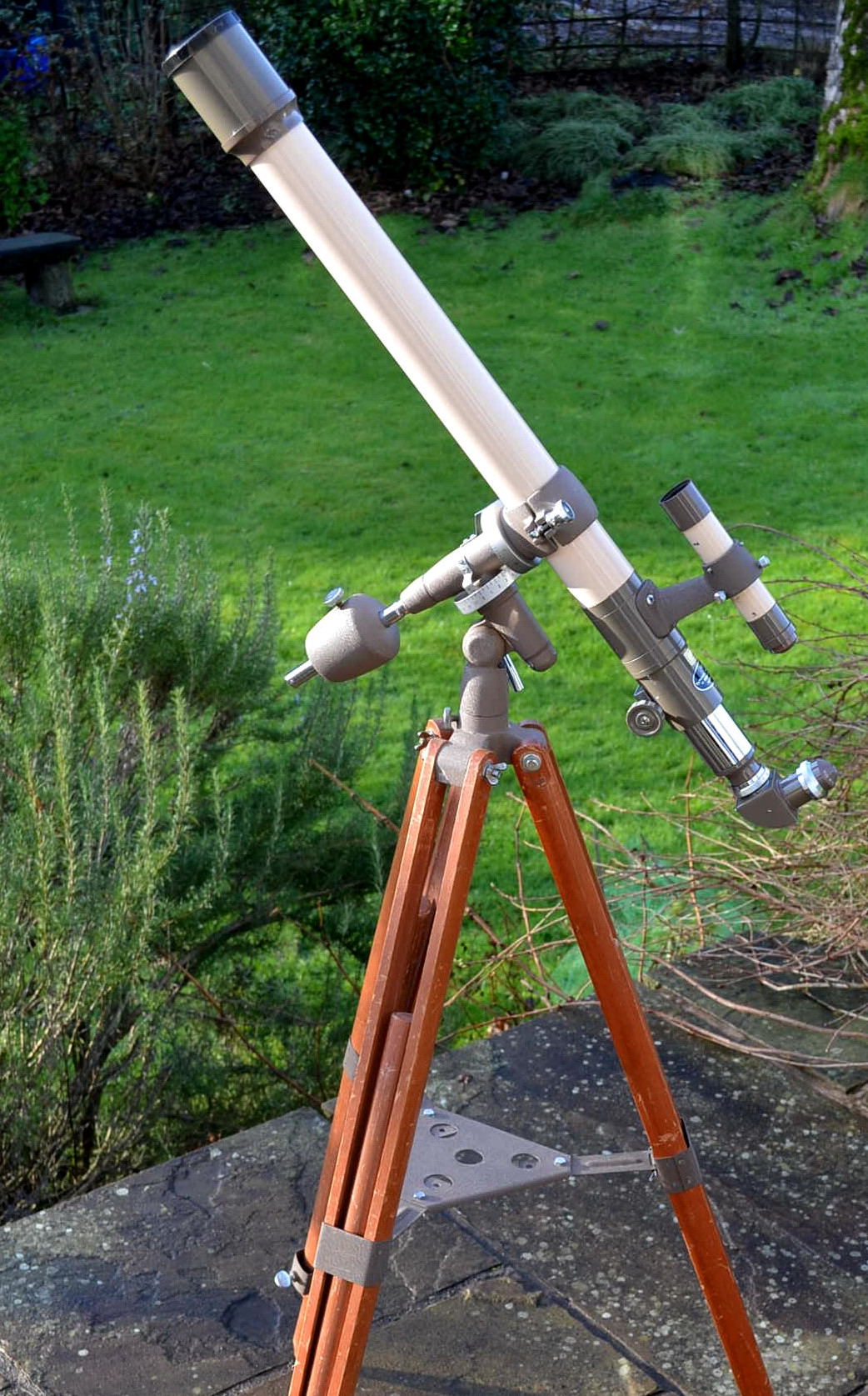
The
Swift mount, with its trademark teardrop weight, is also unique to the brand.
It’s finished in the same dark-coffee crinkle as the finder ring.
Mount
The
mount is a German equatorial, but has no motor or even slow-motion controls;
arguably it doesn’t need them. The push-pull action of the axes is
perfectly weighted and super-smooth with no backlash. Classysilver-on-black
(Takahashi-like again?) setting circles are provided.
The
basic action of the mount is excellent – if only most modern alt-az mounts were this smooth. But it’s not
flawless. One problem is the setup’s weight: so light that it’s
easy to move the tripod when you push the mount axes around and the slightest
nudge of a toe in the dark budges it enough to lose your position in the sky.
That
light weight makes the Model 838 perfect for grab-n-go, from a time before the
idea existed.
A
slightly more serious problem is vibration. The OTA is light but long and
focusing causes a lot of vibration that makes finding critical focus hard at
higher powers. Again, a slight knock whilst viewing causes significant vibes.
Interestingly,
Swift use exactly the same mount for the next model up in size – the 60mm
Model 839 – and a friend who owned one tells me it is ‘very
wobbly’ with the bigger OTA.
Accessories
The
Swift comes in a quality wooden box with a range of accessories. Unusually, the
accessories for the Swift are really good, so I’ll discuss them in
detail. All are 0.965” fit and all feature the same twist-lock mechanism
as the visual back.
The
20mm Huygenian eyepiece is optically quite
decent, but it has little eye relief and a steeply conical top. In the dark,
it’s all too easy to poke yourself in the eye with it – ouch!
The
9mm ‘Sym’ is effectively an Orthoscopic and it’s really quite
good quality, given the same poke factor as the 20mm (my eye still hurts from
last nights’ viewing). However, give the Swift a modern eyepiece, like my
7mm Tak’ ortho’, and it moves to another level.
The
finder is particularly good for an old scope and much better than most cheaper
optical finders today. It’s labelled 5x24 and though the field is narrow
compared to say a Takahashi 5x25, the view is bright and sharp. The objective
is a coated achromat, mounted in a little cell, whilst the eyepiece has
good eye relief. Internally, it’s been properly flat-black painted, so
stray light is no problem and it hasn’t been stopped down unlike many
finders of the era.
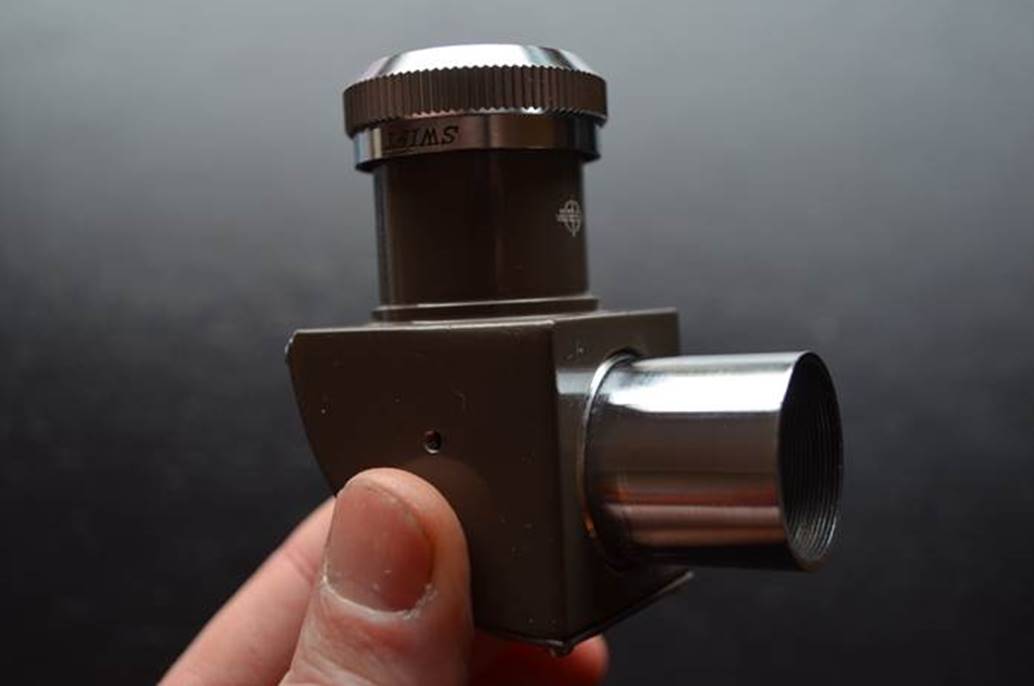
A
good quality 0.965” prism diagonal with a twist grip eyepiece holder
comes with the Swift and like the eyepieces is in the same coffee livery as the
OTA. Doubtless a modern multi-coated version would improve brightness a bit,
but decent 0.965” diagonals are virtually unobtainable now; you’d
need a 0.965”/1.25” adapter to use a larger diagonal.
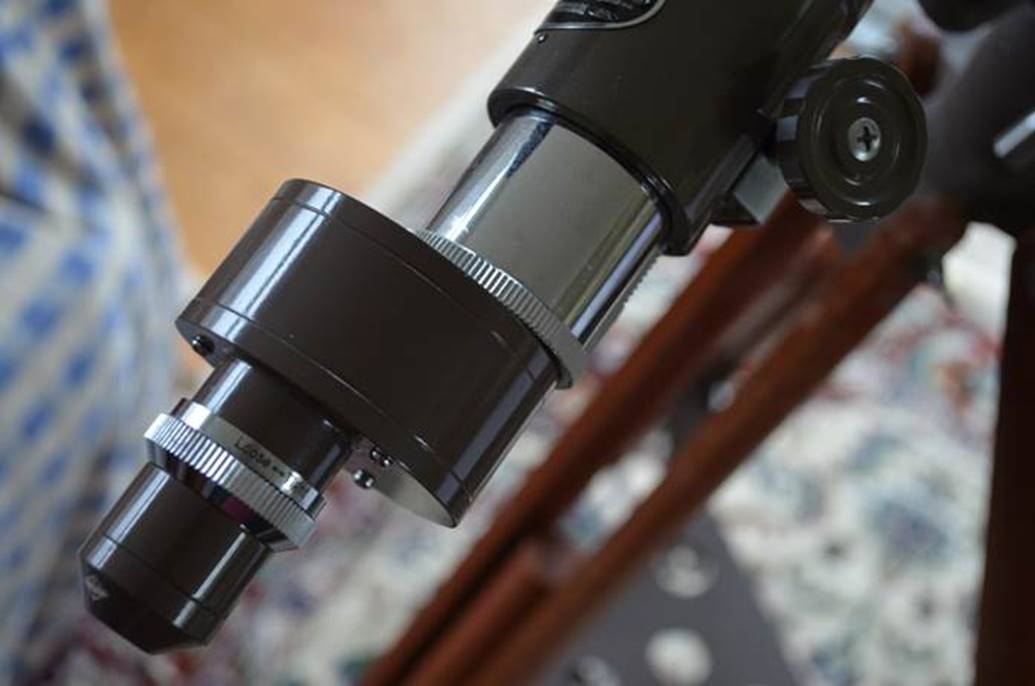
Like
many Japanese telescopes of the day, the Swift comes with an erecting prism.
Unlike almost any other example I’ve seen, this one is a top quality item
that introduces no aberrations at moderate powers and turns the Swift into a
sharp daytime spotter. To use it, you unscrew the visual back and thread in the
prism unit, making it an integral part of the scope and a big improvement over
push-fit.
Finally,
the Swift includes a barlow lens. Once
again, it’s a different from the usual. Most barlow lenses
I’ve seen included with older Japanese scopes are rubbish, so much so
that bad experiences of Tasco’s barlows in
the Seventies gave me a long-held prejudice against the things. Swift’s
is an excellent device, though: metal bodied, clamp ringed (like all the
accessories) and optically so good that introduces no significant aberrations
and works really well.
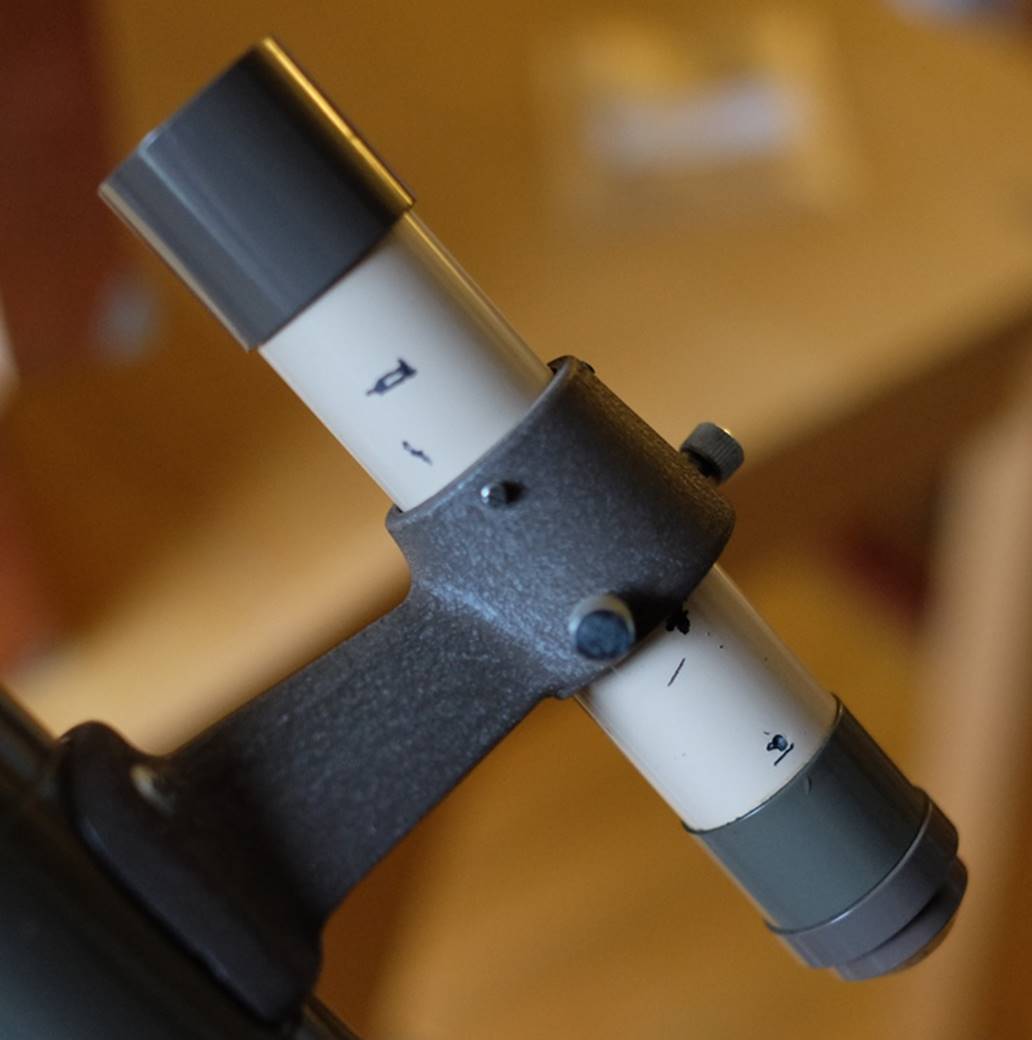
Swift
5x24 finder is scarred on this example, but is still bright and sharp.
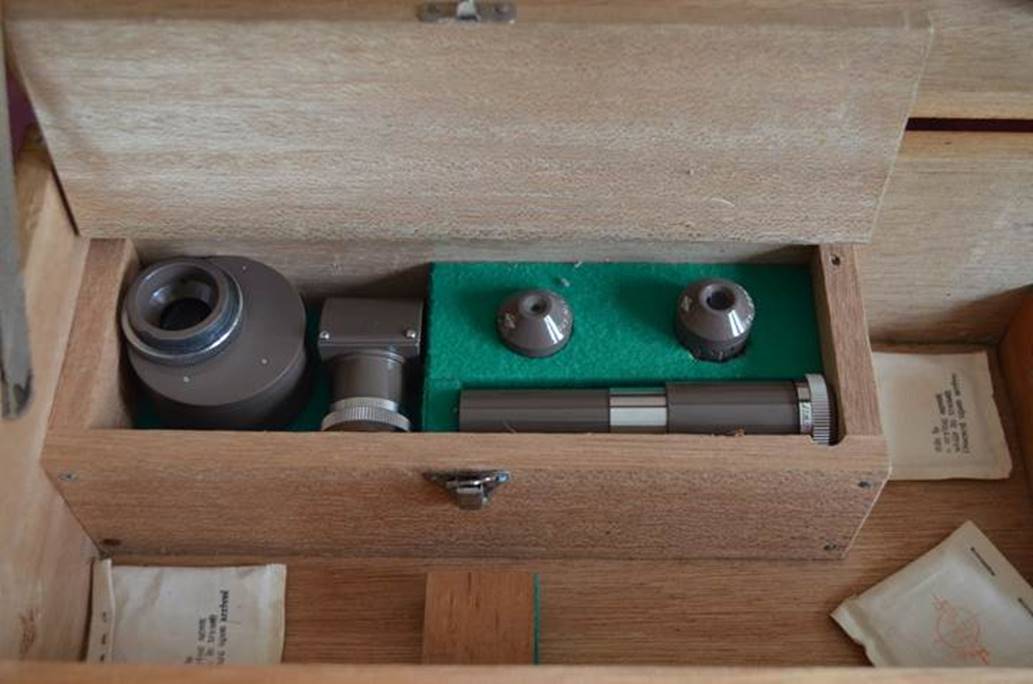
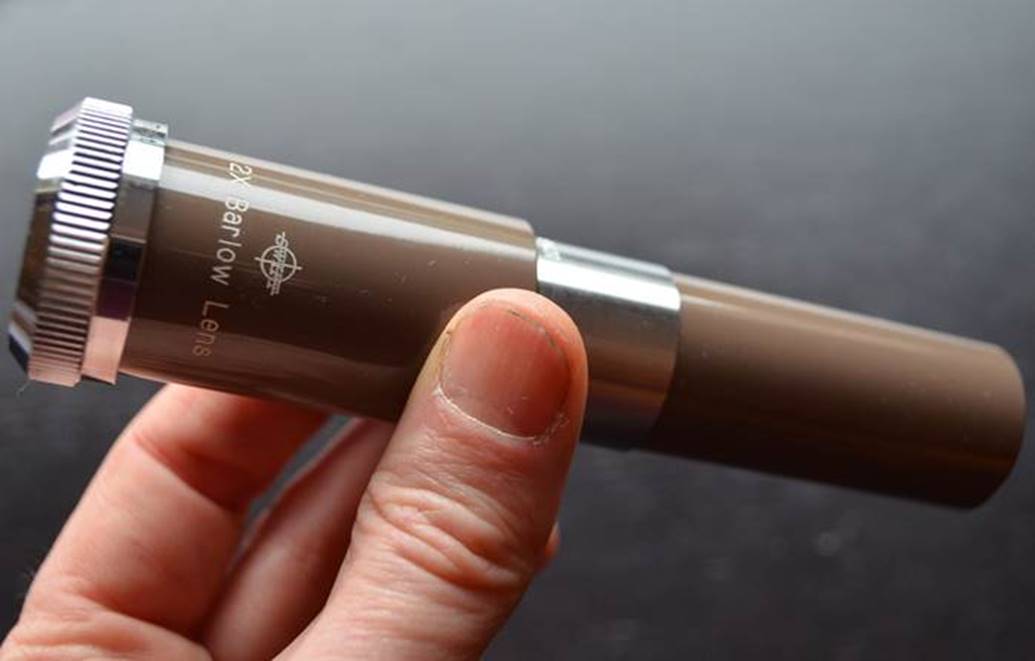
Like
all the other accessories, the Swift barlow is
a good one.
Yes,
but is it a Takahashi?
Do
we have to do this now? Oh alright then … There is a theory going the
rounds that Swifts are basically early Takahashis. But having owned or
reviewed numerous Takahashis, I can categorically state that …
I’m not sure.
The
Swift undoubtedly has features in common with a typical Takahashi, including
the look of the castings, the twist-lock visual back and diagonal, the
clamshell and the design of the focuser. Certainly, the overall quality is
Takahashi-like. But whether these are just features that premium Japanese
makers shared in common at one time, or whether they are evidence of a
manufacturing or design link, I can’t say.
In
Use – Daytime
My
usual test of viewing tree branches against a bright sky at 100x magnification
gives a dim but sharp view. False colour is present at about the level of a
fast doublet APO (think TV-76), so is mainly seen out of focus and isn’t
intrusive.
In
Use – The Night Sky
General
Observing Notes
The
Swift cools very quickly and is a pleasure to use: the focuser is quite smooth,
accurate and free from image shift. Best focus is a very definite point, a snap
if you will, like all good optics.
For
fun, I’ll quote the original Swift manual to see if the description for
each Solar System target is accurate. Sometimes these quotes seem cryptic,
strange or nonsensical – don’t blame me! The same Manual recommends
making a ‘hat trick’ shutter for photography from ‘ordinary
shit cardboard’!
The
Moon
The
Manual Says: ‘Approx. 5000 craters. Dia of minimum spot: 4.5
miles. Width of minimum crevice: 550 yds.’
A
Day 27 crescent in pre-dawn twilight with the standard H20 eyepiece gave
good contrast and a very sharp image at 35x in stable seeing.
The
little Swift holds up well at 100x with a modern 7mm Tak Orthoscopic,
giving a slightly dim view that is completely crisp with surprising detail. As
an example of the limits of its resolution, Rima Huygens is visible at first
quarter, but the Hippalus rilles, at the boundary of
Mare Humorum, are not.
Mercury
The
Manual Says: ‘Disc image can be seen.’
Mercury
is well-defined and obviously not a star, but the disc is still minute at 100x;
Mercury’s phase is barely discernible.
Venus
The
Manual Says: ‘Eclipse can be seen. Ordinarily appears as a crescent
shape.’
Venus
shows a well-defined gibbous disk and no native chromatic aberration (though
lots from the atmosphere). Venus looked good, even low in poor seeing –
perhaps due to the combination of small aperture and long focal length.
Mars
The
Manual Says: ‘Polar cap and Lake Sirutis visible when near
Earth.’ (!!)
Mars
is visible as a tiny orange disk, but I have yet to see any detail through the
Model 838, except perhaps the hint of a polar cap. I am still holding out for
those promised views of Lake Sirutis though.
Jupiter
The
Manual Says: ‘looks elliptical, 2 bands can be seen’
The
little Swift excels on Jupiter, giving a very crisp view with no
chromatic aberration at 100x with 7mm Tak ortho’. Four belts,
the polar hood and some detail in the Southern Equatorial Belt (dark spots) can
be made out at that magnification. Contrast delivery seems excellent for the
aperture.
Jupiter’s
Galilean moons are clearly disks and I was able to watch a shadow transit with
the Swift.
Saturn
The
Manual Says: ’The ring can be seen. Satellites Titan and Rhea are also
visible.’
At
the time of the test, Saturn was still very small, but 100x again delivered a
surprisingly good view for such a small telescope. The rings were clearly
discernible as such (i.e. not as Galilean ‘handles’!), along with
the ring shadow. I couldn’t make out the Cassini division, though.
Deep
Sky
M42
The
Orion Nebula looked quite good through the standard H20mm eyepiece, but a bit
dim due to single coatings (on the eyepiece and prism diagonal, as well as the
objective).
M13
A
surprisingly good view was to be had of this bright globular cluster, but there
was only the vaguest sense of resolved stars with averted vision.
Doubles
Castor
easily split into two hard ‘balls’ with black space between.
Epsilon Lyrae – right on the Swift’s theoretical
resolution limit - was resolved into ‘dumbbells’, but
was not cleanly split.
I
was unable to split Rigel (B was lost in the diffraction rings).
M57
The
Ring Nebula was easy to pick out and showed as a smoke ring with
averted vision, but like M42 was a bit dim.
Summary
The
Swift Model 838 is a beautifully made instrument and is highly usable today,
unlike many classic scopes that have poor optics. The only wonder is that Swift
lavished so much care on a 50mm scope. Having said that, the little Model 838
is light and portable in a way that the bigger Swifts of that era aren’t.
The mount is passable for the 50mm OTA: smooth and accurate, but a
bit vibey.
A
mere two inches aperture it may be, but the Swift’s optics are
essentially perfect and virtually free of chromatic aberration, so it shows you
more than you would expect, especially when it comes to the Moon and
planets. I think I can imagine the thrill the Model 838 must have
given its original owner, peering at Mars and glimpsing the polar cap, whilst
reading Moore’s original Guide to the Planets by a big chrome
‘60’s flashlight.
Unitron may
be the more famous brand, but optically the Swift is far better than the
60mm Unitron I once owned. It’s both a travesty and an
opportunity that classic Unitrons are so
much more expensive than Swifts today.
Incidentally,
the Swift’s optical quality is also better than my 1964 Questar.
It’s
no coincidence that unlike many classic scopes, this
particular Swift has been both well cared for and well used.
Something about the Swift makes it easy to imagine oneself back to 1964 when
using it: an indefinable Sixties character that I really like.
Given
some of the dreadful telescopes made since, it’s chastening to realise
how well a small refractor could be made fifty years ago, back when even some
professional astronomers still believed in Martians.
It
is only a 50mm scope after all, but as a usable and affordable classic, with
top quality optics and mechanicals, the Swift Model 838 is highly recommended.